Your Flatbed Cart Is Costing You More Than You Think

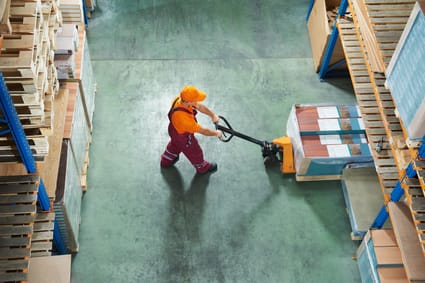
If you’ve spent time on a warehouse floor or in a production facility, you’ve seen it: a worker leaning hard into a heavy cart, shoulders twisted, fighting to steer it around a corner. Maybe you’ve heard the complaints about sore backs, tired arms, or near-misses in tight corridors.

This isn’t just a comfort issue. It’s a productivity problem, a safety liability, and in many cases, the root cause of costly workers’ comp claims and equipment damage.

At DJ Products, we’ve spent decades building powered material handling equipment for exactly these situations. Our latest solution, the Flatbed Chaindrive Remote Steer, was designed specifically for operations that need to move heavy loads through confined spaces, without putting workers’ bodies at risk.

The Real Cost of Manual Material Handling

It’s easy to underestimate what manual maneuvering actually costs your operation. Beyond the obvious ergonomic risks, there are slower cycle times, fatigued workers making poor decisions, and the constant risk of damaging loads, equipment, or infrastructure.

When the loads get heavy, the problem multiplies. Moving anything over a few thousand pounds by hand, even on a wheeled cart, demands significant physical force. Steering a flat cart loaded with machinery or materials through a production line, loading dock, or narrow aisle is a two-person job at minimum. And even then, control is limited.

These are exactly the conditions the Flatbed Chaindrive Remote Steer was built for.

What the Flatbed Chaindrive Remote Steer Actually Does

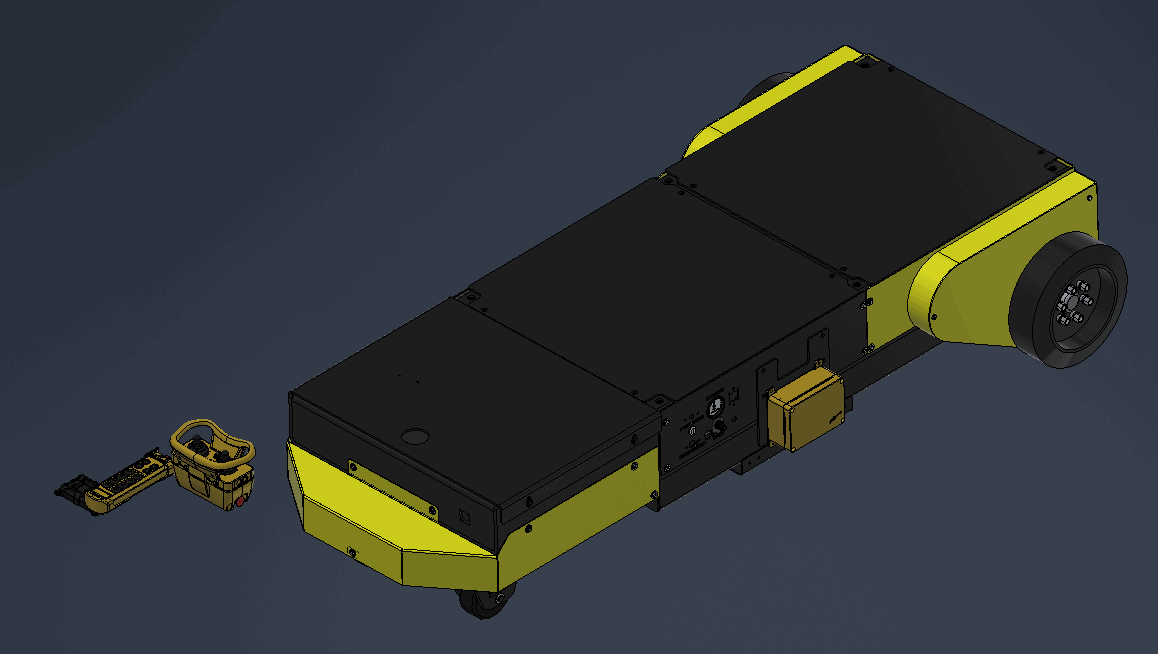
The unit is a powered, remotely steered flatbed transport platform. Material is loaded on top of the flat deck, the worker picks up the wireless remote transmitter, and drives the load where it needs to go. No pushing, no pulling, no strain.

The standard configuration handles loads up to 5,000 lbs. For operations dealing with heavier equipment, the optional 3HP 36VDC drive system scales capacity up to 10,000 lbs. Either way, the operator stays in control at all times, walking beside the unit and steering it with precision.


Key specs at a glance:

  • Load capacity: 5,000 lbs standard (10,000 lbs with upgraded drive)
  • Speed: 0-2 mph forward and reverse
  • Power system: 36VDC electric, three 12V batteries
  • Drive: 1HP continuous (6HP peak), chain-driven to front tires
  • Dimensions: 78.75″ L x 40.5″ W x 15″ H
  • Machine weight: 1,054 lbs with batteries
  • Controls: Handheld wireless remote or optional belly box transmitter
  • Charging: 4.5A onboard charger (15A 3-bank upgrade available)
  • Battery run time: Approximately 8 hours per full charge (2-3 hours at max load)

Designed with Safety at the Center

One of the most common questions we get is about what happens when something goes wrong. The Flatbed Chaindrive Remote Steer is built with a dedicated Emergency-Stop switch on the remote transmitter. Press the red button, and the machine comes to a controlled stop immediately. The motor brake is applied, and the unit won’t move again until the E-Stop is manually released and power is cycled.The system also features a key-switch power control, a main circuit breaker for motor overload protection, and an accessory circuit breaker for the control circuit. An onboard voltmeter lets operators check battery state at a glance before a shift starts.

Optional features include a strobe safety light and an audible horn, both designed to alert nearby workers whenever the unit is in motion.

Who This Unit Is Built For

The Flatbed Chaindrive Remote Steer works best in environments where you have heavy, evenly distributed loads that need to move through spaces that don’t accommodate a forklift. Think:

  • Manufacturing facilities moving large assemblies between workstations
  • Palletized freight repositioning in distribution centers
  • Heavy equipment transport for maintenance shops and service bays
  • Healthcare and institutional settings managing large wheeled loads
  • Any operation where operator fatigue or injury risk is a known concern

The Invert Drive Function: A Detail Worth Knowing

One small but genuinely useful feature is the Invert Drive function. If the operator is positioned on the opposite side of the unit from where steering typically originates, they can hold the Invert Drive button for three seconds to flip the drive direction. This makes it much easier to navigate the unit in and out of tight spaces without repositioning yourself.

Starting the Conversation

Every facility is different. Load weights, aisle widths, surface conditions, shift lengths, and workforce considerations all affect what the right unit looks like for a given application.That’s why we don’t just sell equipment. We talk through the details with you first. The DJ Products sales team has seen hundreds of different applications and can help identify whether the standard configuration covers your needs, or whether an upgraded drive system, alternate battery setup, or custom bed configuration makes more sense.

Ready to see what the Flatbed Chaindrive Remote Steer can do for your operation? Call us at 800-686-2651or request a demo.
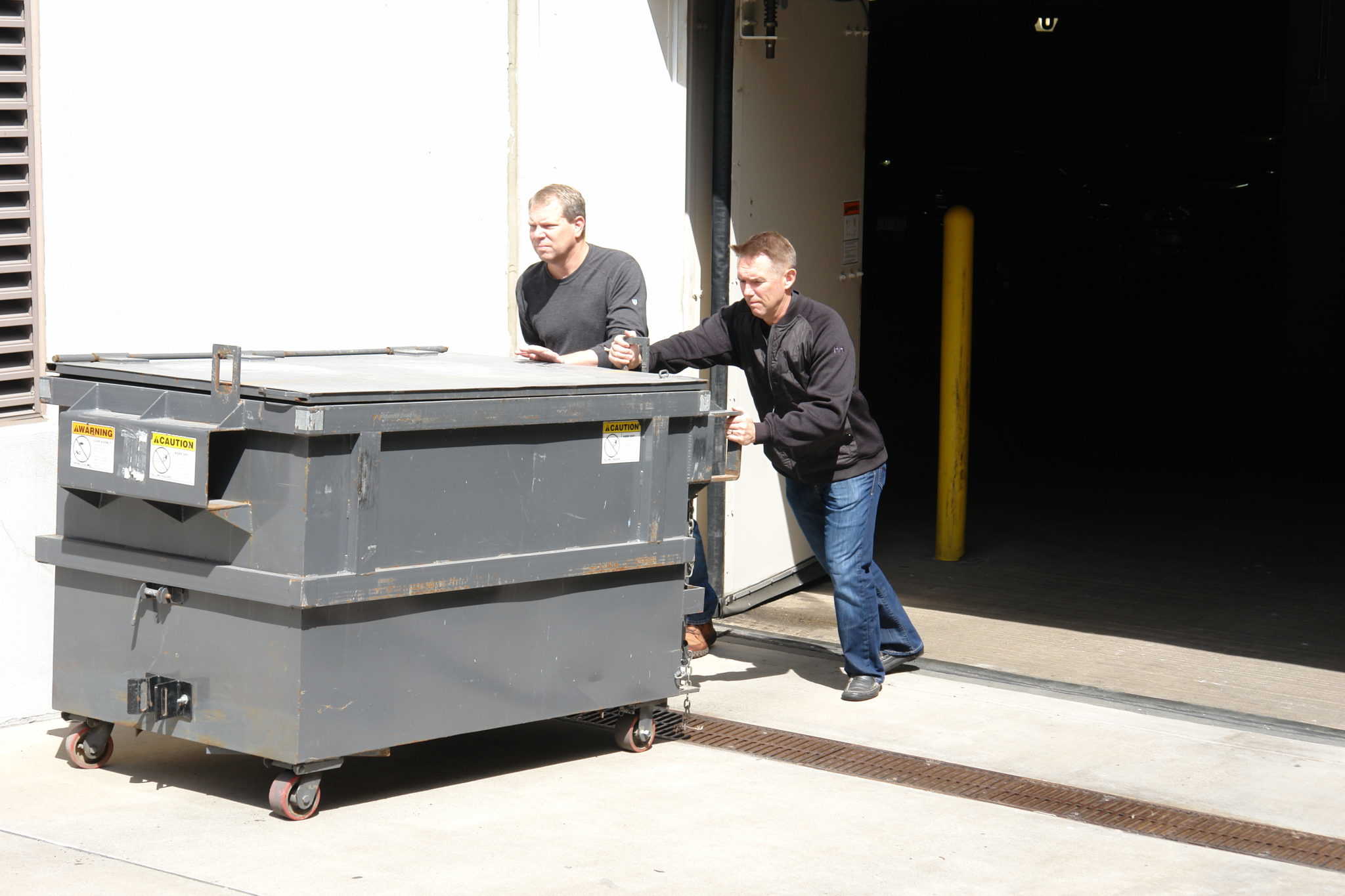
Got to Move a Heavy Dumpster – Use Our Safe Lifting and Pushing Tips

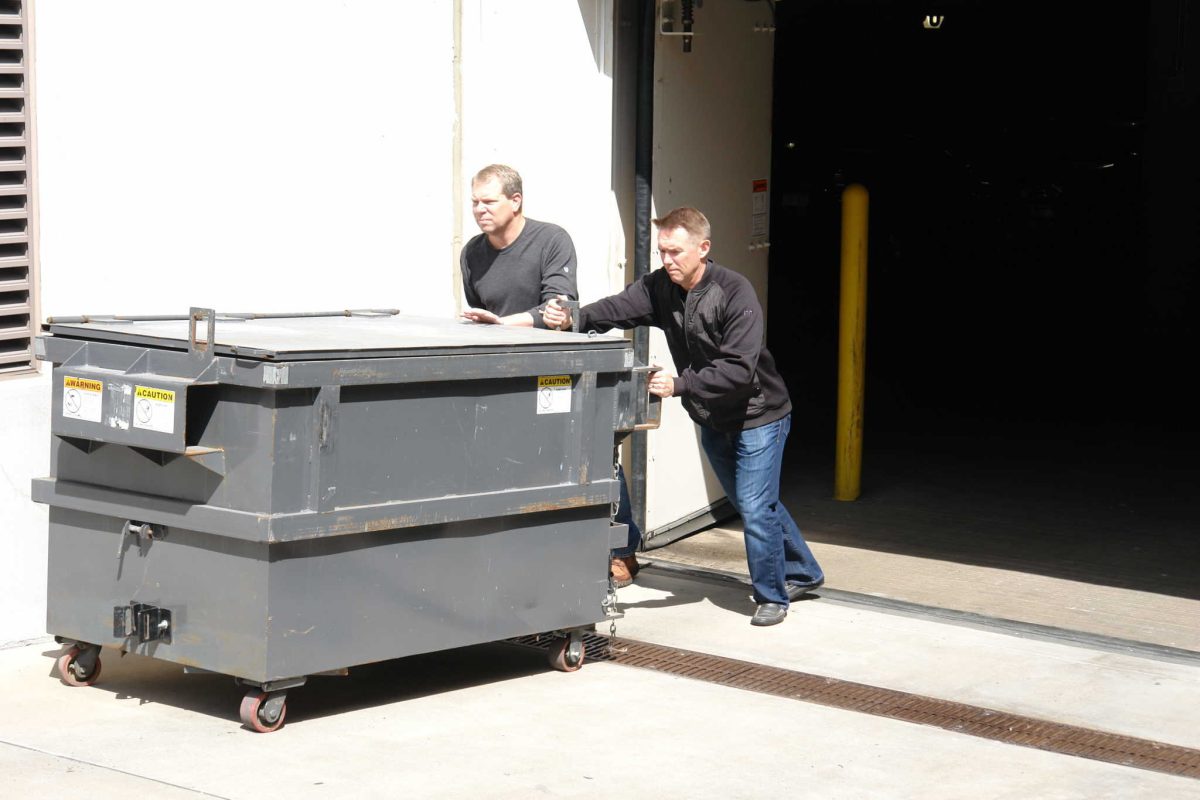
Heavy Dumpster Pushing If you need your employees to move a dumpster, there’s always a risk of injury. Without a dumpster pusher, it’s important to understand how to safely maneuver the dumpster without causing any physical strains or injuries.

To help, we would like to share some safe lifting tips with you. Here are some guidelines in the event that you aren’t sure how to keep yourself or your employees protected during heavy moves.

DJ Products Offers These Safe Lifting Tips

Preventing injury is often easy once you know the proper techniques. If you don’t have a dumpster pusher in house, you should focus on these safe lifting tips:

  • Take a moment to think about the move before you start.
  • Try to keep the weight as close to your waist as possible.
  • Find a stable position to stand before attempting the lift.
  • Make sure you have a tight hold on the load.
  • Lift with your legs. Avoid lifting with your back.
  • Don’t twist your body when you lift.
  • Look ahead and keep moving smoothly.
  • Don’t lift more than you can handle.
  • Put the load down and then make any necessary adjustments.

The Benefits of a Dumpster Pusher

A dumpster pusher offers your business so many great benefits. It can significantly cut down on the manpower it takes to move a dumpster. Also, you may find that the number of injuries your business reports each year will show a marked decrease. For some employers, after reviewing their workers comp claims, they discovered that a high number of injuries were due to moving dumpsters.

We’d love to know how we can help you. Contact us!

Dumpster or Compactor – The Pros and Cons

Before Making a Decision, It's ALWAYS Important to Consider the Pros and Cons.
Before Making a Decision, It’s ALWAYS Important to Consider the Pros and Cons.

Proper trash room maintenance keeps your workplace clean and reduces the risk of injury. Is a dumpster or compactor best suited for your needs? Here’s a look at the pros and cons of each to help you choose the right solution for your application.

Dumpsters and Compactors: What’s the Difference

  • Dumpsters are large metal containers with volumes ranging from 10-yards to 30-yards. They are practical for a wide range of both household and commercial refuse and they are generally emptied by a trash hauling service that picks up every one to two weeks.
  • Trash compactors come in indoor and outdoor models. Thanks to the compressing action they can hold a greater volume of trash, but they’re not recommended for disposal of items such as oils, wood products, electronic items and toxic materials.

Which One Is Right for You?

  • If your business generates a lot of trash on a daily basis and your current garbage containers are being overfilled, a compactor is better for controlling the volume.
  • Dumpsters don’t seal tightly, which means they tend to attract rodents and other pests.
  • How does your trash removal service calculate charges? If it’s by the pickup, a compactor could save you a significant amount of money, but if it’s by the pound, it could be a more expensive option.

Put Safety First with the WasteCaddy from DJ Products

Now that you’ve selected the right container, make another choice for trash room safety. Our best-selling WasteCaddy can transport loaded dumpsters weighing up to 5,000 pounds, preventing the need for manual pushing and pulling.

Visit our website for more information.

Bending, Pushing, Pulling, the Costs of Doing It Wrong May Ring Up a Steep Bill

Be Mindful, Don't Let Your Employees Overexert Themselves... It Could Lead to Serious Injury!
Be Mindful, Don’t Let Your Employees Overexert Themselves… It Could Lead to Serious Injury!

Overexertion from lifting, pulling, pushing, carrying or throwing objects in the workplace ranks as the number one cause of disabling injury, according to the 2016 Liberty Mutual Workplace Safety Index. This type of injury cost employers more than $15.08 billion in direct costs. That is approximately 25 percent of the total direct cost burden relating to workplace injuries for U.S. companies .

Use smart lifting and moving methods

The United States Bureau of Labor Statistics reports that more than 36 percent of injuries that required missed workdays were shoulder and back injuries caused by overexertion and cumulative trauma from lifting heavy objects on a regular basis in the course of work. The Bureau of Labor Statistics says employees can greatly reduce their likelihood of suffering from spinal injuries, pulled muscles, and back sprains by using smart lifting practices and utilizing mechanical methods like material handling tugs when moving heavy loads or objects.

When product or equipment must be lifted manually, employees should place the object in the “power zone” area of the body, which is mid-thigh to mid-chest. They should keep their spine straight whenever possible and bend with their knees instead of their waist. Mechanical lifts and material handling tugs should be used for anything weight more than 50 pounds. The work floor should be designed and laid out in such a way to allow clear passage of forklifts and other equipment essential to safely moving heavy loads.

Improve efficiency for your business and reduce the risk of overexertion injuries to your valuable team members by contacting one of our courteous and knowledgeable sales professionals at DJ Products.

Making Maintenance Easier in Hotels and Apartment Complexes

Working as a porter or on the maintenance crew in a hotel or apartment complex can be an excellent job with good pay that never gets boring.  Depending upon the environment that you work in, your duties may include everything from snow removal in the Winter and landscaping in the Summer to plumbing, electrical and general contracting.  In this line of work there is never a dull moment, but there can be some very stressful and laborious moments if you don’t have the proper equipment on hand to deal with one particularly messy job – trash removal.

Manual trash container removal, especially in complexes that have a large number of apartments, can be a very difficult process.  When a wheeled dumpster gets loaded to the brim or contains some bulky items from tenants who are moving out or redecorating can get exceedingly heavy and potentially dangerous to move manually – this can put porters and maintenance crew members at great risk for injury.

In order to make maintenance crew members safer while performing this less than favorable part of their job as well as more efficient, it helps to have a motorized dumpster mover or waste container puller.   The trash container movers from DJ Products allow one employee to quickly safely and effectively pull the trash container from even tight quarters and get it stationed where it needs to be for pick up.

Even a completely empty dumpster is heavy enough to pose a risk if employees are attempting to manually move it on their own.  With a dumpster mover or trash container puller from DJ Products you can ensure the safety of your maintenance crew and make this task go from the least desirable on the list to one that everyone will volunteer to perform.

Eliminating the Overexertion of Trash Removal

Full dumpsters and trash containers need to be stationed at the right place and at the right time in order to be picked up.  This is critical for apartments, condos and retail establishments that accumulate trash quickly because missing a pick up could potentially create a build up of waste and unsanitary conditions.  For this reason, employees are often asked to do whatever it takes to get the waste container to its destination, which could potentially compromise safety and put employees and property at risk.

The process of getting the heavy waste container, which may weigh in at a few thousand pounds or more, to its destination could involve employees having to push or pull the dumpster over several hundred feet over rough or hilly terrain.  This can be a very dangerous undertaking for one, two or even three employees regardless of the weather, but the high temperatures of the Summer or the ice and snow of the Winter can greatly increase the chance of overexertion and injury.

The battery powered WasteCaddy from DJ Products lets a single employee safely maneuver a fully loaded trash container over any distance and any type of terrain with no worries at all.  The very reliable and ergonomically designed waste container mover makes this job that usually requires multiple employees an easy task for just one employee.

Using properly designed equipment to maneuver heavy dumpsters and recycling bins drastically reduces the chances of injuries, while at the same time increasing productivity by allowing the job to be completed by one employee instead of two or three.  The job gets done faster, easier and with less of a chance of injury or property damage and this is an optimal situation for both management and the employees.

Five Important Dock Safety Tips

Warehouse safety begins at the receiving and shipping docks. Safe dock procedures set the stage for the safe unloading, handling and storage of materials as well as the packing, loading and shipping of product. Identifying and addressing ergonomic challenges on the dock can directly impact worker safety and dock productivity. “You have to look at everything from what kind of trailer you’re going to receive, to whether the load is floor-loaded or unitized to what happens to it after it comes off the truck. Even the temperature inside the facility and the weather are important,” explained Brent Tymensky, VP of design engineering for Fortna Inc.

Dock safety begins with attention to five important issues:

  • Trailer access. The length, width, height and suspension system of a trailer generally determine the dock equipment needed. Other considerations include whether the trailer is dry or refrigerated and whether the load is unitized and fully cubed.
  • Dock conditions. Temperature and weather impact dock worker safety and efficiency. A canopy that keeps out cold, heat, wind, rain and snow improves working conditions and worker comfort. Air-inflatable dock seals can form a tight barrier around a trailer, keeping out the weather and reducing energy costs.
  • Personnel issues. The age, experience and physical condition of your workforce are factors that determine how and when automated and manual equipment are used. Adjustable conveyors that reach into a trailer can assist with manual unloading and loading procedures, reducing the physical strain on workers. While some palletized loads can be off-loaded as is, many pallet loads must be broken down manually into their components for use or proper storage. Adjustable carts and tuggers can make this work both easier and safer for dock workers.
  • Dock safety equipment. Vehicle restraint devices prevent trailers from exiting prematurely while workers are still on the trailer. Restraint devices range from simple wheel chucks to automated systems that bolt into the cement dock and attach to the trailer’s rear guard. A newly marketed interlocking device attaches to the trailer brake emergency airline to prevent the trailer from moving until the dock ramp is removed and the dock door closed.
  • Productivity and efficiency. Dock levelers, extendable conveyors and palletizing equipment all increase efficiency in retrieving and loading materials and goods. Trailer drop can significantly hinder the transition from the trailer to the dock. Levelers and vehicle restraints that support the rear of the trailer can eliminate trailer drop as equipment is moved into the trailer for loading or unloading.

Always be Prepared

The Occupational Safety and Health Administration, also known simply as OSHA, is responsible for setting and enforcing the standards of safety in the workplace.  The main goal of OSHA is to reduce on the job injuries and fatalities by assuring that workers are performing their jobs in the safest environments possible.  Since it’s inception at the end of 1970, OSHA has dramatically reduced the incidents of accidents in the workplace and they continue to inspect facilities and enforce their policies in an effort to make working people even safer.

Between the federal and state run divisions of OSHA, more than 100,000 facilities are inspected each year and those not meeting the standards could receive heavy fines depending upon their infractions.  The number one violation cited by OSHA has to do with forklift operation.  This should serve as a warning to all warehouse and distribution environments that if they are operating outdated and unreliable equipment or if they haven’t properly trained their employees on correct usage procedures of equipment that they could suffer citations and heavy fines from OSHA.

There is much more at stake though than a fine, operating your facility with under trained employees or old and unreliable equipment could make your facility run poorly, inefficiently and it can put the health of your employees in jeopardy.  In order to have the safest facility possible you need to be running equipment that was designed for the tasks that your employees perform and you need to properly train your workers to operate that equipment.

Electric lifts and carts from DJ Products are designed with safety and performance in mind – they are easy to operate, ergonomically designed and can last for an entire shift on a single charge.  Properly using the right equipment is the first step to a safer, more effective and more efficient workplace – and it will eliminate the most cited infraction of the standards set by OSHA and keep you one step closer to compliance.

More Companies Going Forklift-Free

An increasing number of companies, particularly in the manufacturing, warehousing and logistics industries, are moving toward a forklift-free environment. Safety concerns and maintenance costs are the primary factors driving this major change in material handling application.

According to a recent study by the Hyster Company, a major manufacturer of forklift trucks, only 6% of end-users know their real forklift maintenance costs and few have implemented programs to reduce those costs. Over the 20-year life of a forklift, 80% of the total costs are operating expenses. Ownership accounts for only 20% of a forklift’s total cost. The Hyster study estimates that American businesses waste more than $1 billion per year in unnecessary material handling operating costs.

Far more expensive are the human loss and liability costs directly tied to forklift injuries each year. Each year, nearly 100 U.S. workers are killed in forklift accidents and another 20,000 seriously injured. Forklift overturns cause 25% of forklift-related deaths. Medical expenses, insurance costs, workmen’s compensation and lost man-hours associated with forklift accidents cost American businesses millions of dollars each year.

According to John Neuman and Larry Tyler, writing in American Machinist, a forklift-free program can have multiple benefits, including:

  • reduced inventory,
  • improved material flow,
  • reduced line-side handling equipment,
  • reduced floor space,
  • increased cycle efficiency,
  • increased floor coordination,
  • increased stocking efficiency, and
  • decreased operating costs.

On the human side, a forklift-free environment improves investor, worker and public perception of a company’s attention to safety. It improves worker ergonomics, efficiency and production and decreases expensive lost man-hours, medical, insurance and liability costs.

Next time: Implementing a forklift-free program.

Material Handling Solutions for Big Box Stores

With the current state of the economy, everyone is trying to do whatever they can in order to save some money.  That has many consumers buying in bulk at big box/outlet stores in an effort to spread their money out just a little bit more.

Outlet stores operate like a cross between a warehouse and a retail establishment, which poses some differences and potential problems with actually getting the material from receiving to the sales floor where customers have the opportunity to purchase.

It’s absolutely crucial for these types of environments to have safe and reliable equipment in order to meet the customer’s needs.  The employees need to be able to move large quantities of product literally among the customer base during business hours, so safety is a huge concern.  No outlet store can operate successfully with loud and difficult to operate equipment – all material handling equipment needs to be easy to operate and not overly disruptive to the consumer experience.

Once the safety of the employees and customers has been taken care of, reliability is the second biggest concern.  Even the slightest failure of material handling equipment in a big outlet store could spell disaster as much of the material moves directly from receiving to the sales floor in bulk loads.  If the equipment is not functioning for even a short period of time, there could be dozens and dozens of lost sales and potentially lost customers.

Properly trained, reliable employees and reliable equipment are two of the biggest keys to the success of big box and outlet stores.  Reliable equipment ensures that the material hits the sales floor in a timely manner and is available for sale when the customers are looking for it.