
It’s Time to Learn About Ergonomics in the Warehouse as an Injury Prevention Protocol

Make Work a Little Easier on Yourself - Ergonomic Designs In the Workplace are the Future.
Make Work a Little Easier on Yourself – Ergonomic Designs In the Workplace are the Future.

Our battery-powered tugger carts are ergonomically designed to prevent carpal tunnel syndrome and other injuries caused by repetitive motions. How much do you know about ergonomics and the role they play in maintaining a safe warehouse?

Observing ergonomic principles allows workers to be more productive while reducing physical stress. Here’s a look at how you can put ergonomics to work in your warehouse.

What Is Ergonomics?

Ergonomics, sometimes referred to as human engineering, is broadly defined as “the study of the relationship between workers and their environment.” The ultimate goal is to design the workplace for optimum efficiency and less physical wear and tear.

Whenever possible, work motions should be centered around the “golden zone,” which refers to the body’s core between shoulders and knees. Workers should rarely, if ever, have to reach above their shoulders or below their waists.

Types of Ergonomic Injuries

Ergonomic injuries tend to fall under two categories:

– Lifting and handling injuries occur when heavy boxes, pallets and other loads are placed too high or too low.

– Overexertion injuries result from repetitive motions, such as long walks during order-picking.

Ways to Improve Ergonomics

– Slot SKUs appropriately with high-volume items placed close by.

– Install pallet flow racks so a case is ready at the point of pick.

– Use tilted pick trays for items stored higher in the rack.

– Train employees in the proper operation of tugger carts and other equipment.

– Encourage workers to report unsafe conditions or inefficiencies in workflow.

– Prioritize regular housekeeping to eliminate cluttered aisles and other hazards.

Ergonomically Designed Tugger Carts from DJ Products

Electric tugs such as our best-selling CartCaddyShorty reduce the risk of both lifting and handling and overexertion injuries. Visit our website and learn more from our helpful sales engineers.

A Focus on Ergonomics Can Prevent Warehouse Injuries

iStock_000020130432_Small
Thinking Smarter About How We Travel and Transport Never Hurts to Think About.

Warehouse and fulfillment center workers perform a number of physically demanding and repetitive tasks on a daily basis, creating a high risk for musculoskeletal injuries. Our warehouse equipment is ergonomically designed to be safer and less stressful on muscles and joints.

Create a culture of safety awareness in your warehouse by training employees to incorporate these ergonomic principles in their everyday activities.

Placing and Picking Items

– Take a position squarely facing the item’s location to avoid twisting the spine.

– Keep movements between shoulder and knee height as much as possible.

– Don’t stack carts in such a way that the field of vision is obstructed.

Packing Shipments

– Maintain a neutral posture: straight neck and back, shoulders down, elbows at right angles, wrists straight.

– Organize products and packing materials in a way that eliminates excessive stretching, twisting or lifting.

– Minimize intensity of gripping, pinching and other forces required to complete tasks such as taping and filling packages.

– Use carts, roller tables and other conveyances to limit the need to manually carry items.

Receiving and Shipping

– Don’t overload pallets. Balance loads with larger, heavier items on the bottom and smaller, lighter items on the top.

– Use mechanical assistance such as our tugs, movers and pushers to transport heavy or bulky loads, especially ones that usually require two or more workers.

– Follow proper lifting techniques: stand as close as possible with feet shoulder-width apart, bend at the knees instead of the waist, lift from the legs. Reverse these steps when lowering items.

Improve Safety and Reduce Downtime with Warehouse Equipment from DJ Products

Workplace injuries cost time and money, putting a double whammy on productivity. Let our sales engineers recommend the best electric warehouse equipment for your applications. Visit our website to learn more.

What Are the Benefits of a Focus on Ergonomics When It Comes to Trash Moving?

What Are the Benefits of a Focus on Ergonomics When It Comes to Trash Moving?

Have you looked at your trash room from your employees’ point of view? What looks like an efficient layout may actually be subjecting workers to undue physical stress, putting them at risk for injuries and reduced productivity.

An ergonomically designed workplace takes into account employees’ capabilities and limitations to ensure maximum performance with minimum strain. Here are some valuable benefits ergonomics can have for your company.

How Ergonomics Improves Your Workplace

  • Injury insurance claims have an impact on the bottom line that goes beyond the obvious. Roughly 33 percent of workers compensation costs are expended on musculoskeletal injuries, while lost productivity and other indirect costs multiply that by up to 20 times.
  • In addition to physical injuries, poor ergonomics can cause general fatigue and frustration. While employees might be healthy enough to work, they may be too tired and demoralized to put forth full effort.
  • Concern for your employees’ health and welfare promotes an overall culture of safety, which in turn improves morale. When employees feel appreciated, they’re more engaged in their work and less likely to leave.

Improve Worker Safety with a Dumpster Pusher from DJ Products

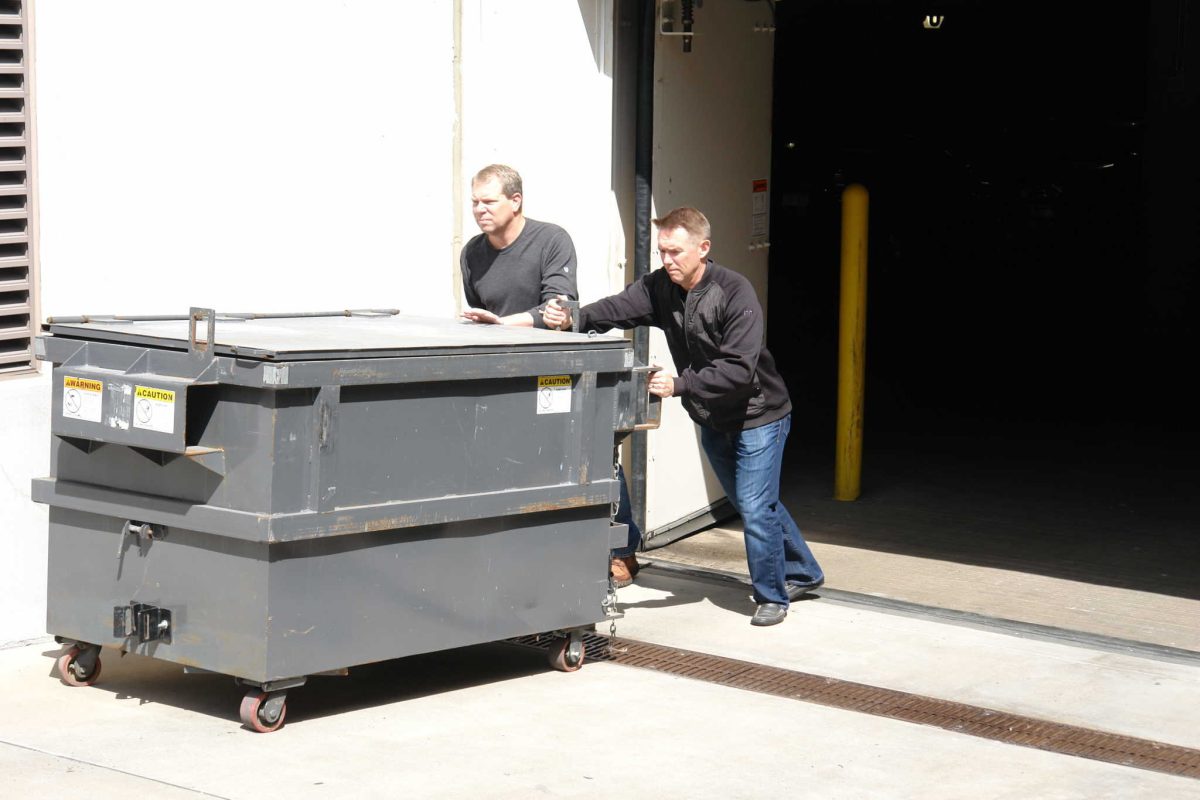
Our customers have discovered that a high number of injuries such as back and shoulder strains and pinched fingers were a result of moving bulky dumpsters up and down inclines and around tight corners. Bringing in temporary replacements unfamiliar with the job only made matters worse.

As one customer put it, using our WasteCaddyLite dumpster pusher is “like having another employee on staff.” Visit our website to learn more about how our ergonomically designed dumpster pusher can improve safety at your workplace.

The Business Case for Investing in Equipment that Prevents Back Injuries

DJ Products Waste Caddy is an Investment in Your Employees' Health
DJ Products Waste Caddy is an Investment in Your Employees’ Health

Data from an older article stated that on average, nearly 50 workers are injured during any given minute of the work week. The American Society of Safety Engineers (ASSE) published a 2002 report that workplace safety programs benefit both your company and your employees. Fast-forward to today. This data makes a good business case that using WasteCaddy dumpster movers to prevent back injuries is a wise investment.

Safety by the Numbers

In that article, workplace injuries resulted in $128 billion in losses in 1996, which equated to 25 percent of pre-tax net profits. Even in today’s business environment, indirect costs can inflate direct costs by a factor of 20. Some of these include:

• Hiring, training and paying replacement labor

• Reduced productivity

• Investigation time and implementation of corrective measures

• Absenteeism and low employee morale

• Poor reputation in the community and industry

Many of these costs can continue long after the actual occurrence of the injury.

Raising Safety Awareness

The report cited a survey showing that employers buy into the importance of heightened safety practices regarding business and human costs. The top two reasons given were the cost of workers’ compensation insurance and the “right thing to do.”

There is real-life data to support the cost-effectiveness of safety programs:

• Companies have seen a return of up to $6 for every $1 spent on workplace safety.

• After investing in their safety program, a West Virginia coal mining company saw its workers’ compensation rate drop to $1.28 per $100 in payroll, compared to a competitor’s rate of $13.78.

Reduce Back Injuries with Electric Tugs from DJ Products

Our WasteCaddy dumpster mover enables a single employee to safely and easily handle one of the more labor-intensive tasks in the workplace. Call 800.686.2651 to learn more.

Making Maintenance Easier in Hotels and Apartment Complexes

Working as a porter or on the maintenance crew in a hotel or apartment complex can be an excellent job with good pay that never gets boring.  Depending upon the environment that you work in, your duties may include everything from snow removal in the Winter and landscaping in the Summer to plumbing, electrical and general contracting.  In this line of work there is never a dull moment, but there can be some very stressful and laborious moments if you don’t have the proper equipment on hand to deal with one particularly messy job – trash removal.

Manual trash container removal, especially in complexes that have a large number of apartments, can be a very difficult process.  When a wheeled dumpster gets loaded to the brim or contains some bulky items from tenants who are moving out or redecorating can get exceedingly heavy and potentially dangerous to move manually – this can put porters and maintenance crew members at great risk for injury.

In order to make maintenance crew members safer while performing this less than favorable part of their job as well as more efficient, it helps to have a motorized dumpster mover or waste container puller.   The trash container movers from DJ Products allow one employee to quickly safely and effectively pull the trash container from even tight quarters and get it stationed where it needs to be for pick up.

Even a completely empty dumpster is heavy enough to pose a risk if employees are attempting to manually move it on their own.  With a dumpster mover or trash container puller from DJ Products you can ensure the safety of your maintenance crew and make this task go from the least desirable on the list to one that everyone will volunteer to perform.

Eliminating the Overexertion of Trash Removal

Full dumpsters and trash containers need to be stationed at the right place and at the right time in order to be picked up.  This is critical for apartments, condos and retail establishments that accumulate trash quickly because missing a pick up could potentially create a build up of waste and unsanitary conditions.  For this reason, employees are often asked to do whatever it takes to get the waste container to its destination, which could potentially compromise safety and put employees and property at risk.

The process of getting the heavy waste container, which may weigh in at a few thousand pounds or more, to its destination could involve employees having to push or pull the dumpster over several hundred feet over rough or hilly terrain.  This can be a very dangerous undertaking for one, two or even three employees regardless of the weather, but the high temperatures of the Summer or the ice and snow of the Winter can greatly increase the chance of overexertion and injury.

The battery powered WasteCaddy from DJ Products lets a single employee safely maneuver a fully loaded trash container over any distance and any type of terrain with no worries at all.  The very reliable and ergonomically designed waste container mover makes this job that usually requires multiple employees an easy task for just one employee.

Using properly designed equipment to maneuver heavy dumpsters and recycling bins drastically reduces the chances of injuries, while at the same time increasing productivity by allowing the job to be completed by one employee instead of two or three.  The job gets done faster, easier and with less of a chance of injury or property damage and this is an optimal situation for both management and the employees.

Ergonomic Equipment Cuts Strain on Depleted Workforce

News continues to look dire for the labor market. The Conference Board Employment Trends Index, or ETI, continued to decline in October. Down nearly 12% from a year ago, the index fell to 105.3 in October, a further 2% decrease from its September level. And the future isn’t looking good, said Conference Board Senior Economist Gad Levanon who predicts continued deterioration of the labor market and rising unemployment rates well into 2009.

“The economic developments of the last two months made it clear to businesses that demand for goods and services in the U.S. is declining, and businesses are responding by aggressively slashing their payrolls,” said Levanon in an interview published in Manufacturing & Technology eJournal. “Unfortunately, it seems this environment will persist for several more quarters and business leaders will continue reducing their workforce.”

Published monthly by the Conference Board, a global non-profit business organization that monitors and forecasts economic trends, the ETI is a compilation of eight labor-market indicators:

  • percentage of workers who find jobs “hard to get”
  • initial unemployment insurance claims
  • percentage of companies with job openings
  • number of temporary hires
  • number of part-time workers working for economic reasons
  • number of job openings
  • industrial production rates
  • real manufacturing and trade sales

Whether we like it or not, in a recession most businesses are forced to trim labor costs in order to survive. It’s happening in every sector of U.S. economy. From retail sales to office workers to manufacturing, layoffs are occurring, workforces are being downsized and retiring workers are not being replaced. This means fewer workers must shoulder greater burdens if production quality and output are to be maintained.

Ergonomically-designed equipment easily enables a single worker to do a job that may previously have required two or more workers when performed manually. By transferring physical effort from the worker to the equipment, ergonomically-designed carts and equipment movers allow business owners to effectively reduce their workforce without taxing their workers.

Ergonomic equipment is designed to prevent the expensive and debilitating musculoskeletal injuries that plague manual pushing, pulling and lifting tasks.  The introduction of ergonomic equipment and ergonomic practices into the workplace have been shown in countless studies to immediately reduce worker injury, decrease associated medical and insurance costs and improve worker morale and productivity.

To find out how ergonomically-designed equipment can help you maintain production values with a depleted workforce, talk to the ergonomic experts at DJ Products.

Freight Solutions for Small and Medium Sized Warehouses

A forklift is a great asset for moving palletized freight or heavy loads from point a to point b in your facility, but not every plant or warehouse that handles heavy loads has the storage capacity or room to maneuver for a forklift to be a viable option.  In many of these establishments, employees are manually handling these heavy loads and workers are risking injury every single day in order to perform their job.

You don’t need extra wide aisles in order to operate a powered machine that can move heavy equipment or loads from one end of your warehouse to the other; you can get the same power delivered by a full sized fork truck in the smaller and easier to maneuver CartCaddy4SC powered hand truck from DJ Products.

The CartCaddy4SC allows workers to quickly, safely and easily handle loads up 4,500 pounds in situations where a full sized forklift would be too big a piece of equipment.  The CartCaddy4SC can also be an incredible compliment to a full sized forklift in high volume warehouses that require multiple large loads to be handled at the same time but that don’t have the budget, need or space to merit having two forklifts on site.

Just like all of the material handling equipment from DJ Products, this powered hand truck is built with both functionality and safety in mind.  This piece of equipment is easy to use, quiet, ergonomically designed and can run for a full eight hour shift with regular use on a single charge.

Your business can operate much more smoothly and safely with the proper equipment for the job and if you need heavy loads moved in tight quarters or need to safely get heavy equipment or stock from one place to another while your forklift is in use elsewhere – your business could certainly benefit from having a powered hand truck on site.

Pushmi-Pullyu Mentality Increases Workplace Injury

Remember the Pushmi-pullyu (push-me-pull-you) from Hugh Lofting’s Dr. Dolittle stories for children? It was an antelope with two heads, one on each end of its body. (In the popular Eddie Murphy movies, they used a llama.) Whenever the creature wanted to move, both heads would take off at once, pushing and pulling back and forth and going nowhere. Since pushing and pulling exert two of the greatest stresses on the body, the poor critter must have been in constant need of the good doctor’s chiropractic skills! That same Pushmi-pullyu mentality toward workplace task and equipment design can put your employees at serious risk of sustaining disabling musculoskeletal injuries.

Pushing, pulling, lifting and carrying tasks place a greater strain on the human body’s soft tissues — muscles and tendons — than any other tasks. These tasks are also universal to nearly all work environments. Wheeled carts, platforms or equipment must be loaded and unloaded and pushed and pulled through manufacturing plants, distribution centers, hospital corridors, grocery store aisles, hotel hallways, office buildings and retail establishments. Most jobs require at least occasional pushing, pulling, lifting or carrying; and many jobs require workers to spend their entire workday engaged in these activities, performing the same, repetitive movements hour after hour. The cumulative wear and tear on the body can lead to serious injury of soft tissues and eventual disability.

Too often tasks, work spaces and equipment aren’t designed to accommodate the natural differences in the size and physical capabilities of workers. A task performed first shift by a six-foot, 180-pound, 25-year-old male may be performed second shift by a five-foot three-inch, 130-pound, 45-year-old female and third shift by a five-foot seven-inch, 260-pound, 60-year-old male. Because work tasks and equipment are usually designed around a “standard” worker type — which, unfortunately, few workers match — most workers are forced to assume awkward postures while exerting force to complete work tasks. Serious, debilitating strains and sprains can result, particularly when these actions are repeated over time.

When soft tissues in the arms, shoulders, back and legs are injured, the tissues recover, though it may take some time. But repeated injury, particularly when it occurs before tissues have had time to fully recover, interferes with the body’s natural healing process, overwhelming the body’s ability to recover and leading to permanent, disabling injury. Such cumulative traumas are called musculoskeletal disorders. Also referred to as repetitive stress injuries and repetitive motion injuries, these serious, disabling strains and sprains cost U.S. businesses tens of billions of dollars each year.

Next time: Ergonomics; just what the doctor ordered.

Tips for Creating a Successful Ergonomics Program

Last time we talked about the financial and production benefits of implementing an ergonomics program (see our Nov. 24 post). A recent study on the bottom-line value of ergonomics showed a $4 savings for every dollar invested. Most businesses that purchase ergonomic equipment recoup their investment costs within the first year. The financial benefits alone make ergonomic equipment a shrewd investment in your future. But forward-thinking businesses that investment in ergonomics understand that they are also making a powerful proactive investment in the health, safety and retention of their workforce.

Creation of a successful ergonomics program requires three important elements, Mike Kind wrote recently in the New Hampshire Business Review:

Support of top management. To be successful, an ergonomics initiative must become part of your corporate culture and be thoroughly embraced and supported by top management. The introduction of an ergonomics program can be an excellent step toward creating a wellness-based focus in your organization, notes Kind.

Other wellness-centered activities include offering wellness training classes, scheduling health screenings and flu shots, providing healthier snacks and beverages in vending machines, sponsoring Weight-Watchers groups, offering gym membership discounts. Employers only stand to gain from sponsoring activities that promote a healthy workforce.

Established goals and measurable results. Any new initiative requires a bit of tweaking once it’s off the launch pad. Particularly in the early weeks of a launch, it’s important to conduct regular workplace assessments of a new ergonomics program to ensure that maximum efficiency and productivity are achieved. Close monitoring of employee complaints, injury reports, medical costs, workers’ compensation claims, absenteeism, lost man-hours and production results will provide the hard data needed to assess the success of your program and make any necessary changes.

Kind adds a word of caution: Don’t be surprised if you find an initial increase in incident reports. As employees learn about ergonomic issues, they are more likely to recognize the symptomatic causes of musculoskeletal complaints and report them. As your ergonomics program progresses and becomes an effective component of corporate culture, incidence reports will decrease significantly.

Next time we’ll discuss the importance of effective education, training and leadership in implementing a comprehensive ergonomics program in your workplace.