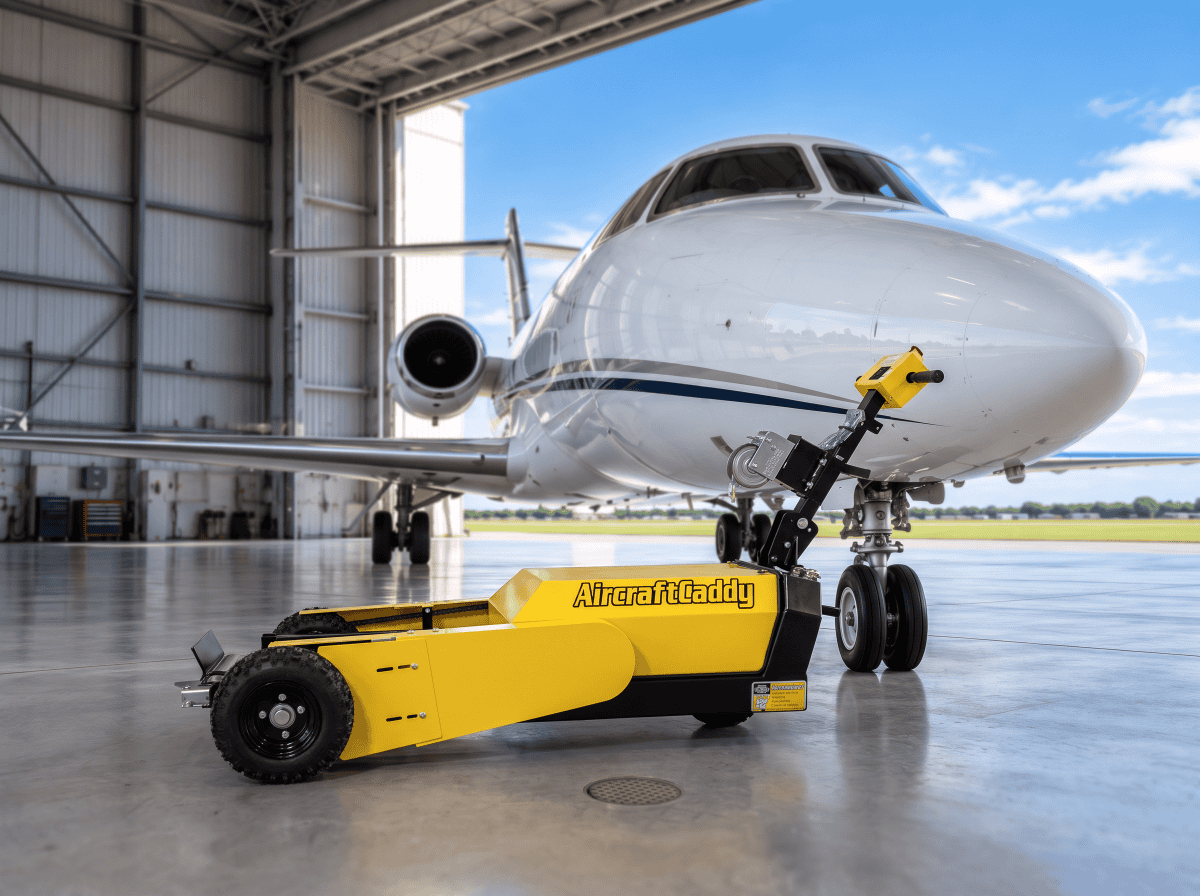
Battery-Powered Aircraft Tugs: A Buyer’s Guide to Aircraft and Hangar Fit

Choosing a battery-powered aircraft tug starts with aircraft compatibility, towing capacity, supported nose gear weight, route conditions, low-speed control, and charging requirements. Evaluate these together before selecting a model or comparing prices.

An aircraft’s weight helps narrow the options. The connection method, hangar layout, and daily workload determine whether a shortlisted tug fits the job.

For FBOs, flight schools, corporate flight departments, maintenance teams, and private hangar owners, the goal is practical: equipment that can handle the complete move, from connection and loading to final parking and unloading.

What should you compare when buying an aircraft tug?

Use the same requirements for every provider so you can compare proposals consistently.

Selection factor What to confirm
Aircraft compatibility Exact aircraft model, landing gear configuration, wheel dimensions, wheel pants, and approved towing method
Towing and support capacity Aircraft towing weight and the load the tug must support at the nose wheel
Route conditions Slopes, pavement, grass crossings, door tracks, surface transitions, and expected weather
Hangar fit Doorway clearance, wingtip path, turning space, and final parking position
Control Loading, gradual starts, small adjustments, stopping, and unloading
Battery and charging Expected workload, available charging time, electrical supply, and temperature limits
Ownership cost Equipment, attachments, batteries, maintenance, training, parts, and support

A proposal should explain how the recommended configuration meets these requirements and identify any operating limitations.

Start with the aircraft and daily workload

A flight school making repeated moves has different needs from an owner taking one aircraft out of a private hangar. An FBO handling several aircraft types also needs to understand connection changes between aircraft.

Before requesting quotes, gather:

  • Aircraft makes, models, and expected towing weights
  • Nose wheel, dual nose wheel, or tailwheel configuration
  • Photos and dimensions of the intended connection area
  • Wheel pants and nearby clearance restrictions
  • Number of moves per day and approximate distance per move
  • Hangar opening dimensions and the tightest parking turn
  • Route photos showing slopes, door tracks, and surface changes
  • Charging location and available charging time

For a mixed fleet, list each aircraft separately. Compatibility with one aircraft does not establish compatibility with every aircraft in the same weight range.

Understand towing capacity and nose gear support capacity

Towing capacity describes the aircraft weight a tug is rated to move under the manufacturer’s specified conditions.

For a tug that supports the nose wheel, the maximum supported nose gear weight is a separate limit. It describes the load the tug’s cradle or lifting arrangement can carry.

Both must suit the aircraft’s intended loading condition. Being within the towing rating does not automatically mean the nose gear load is within the support rating.

Use the aircraft’s documentation and weight-and-balance information to establish the relevant weights. Ask the aircraft manufacturer or a qualified aircraft professional for clarification where needed.

Then ask the tug provider to confirm those requirements against the exact configuration being quoted.

Check the conditions behind the rating

Ask whether the quoted towing capacity applies to your route.

An incline changes the force needed to move and control the aircraft. Surface conditions can affect rolling resistance, traction, or both. A level, dry pavement rating alone does not establish suitability for a sloped driveway, grass crossing, or winter operation.

Provide the slope, surface, and aircraft weight, then request a configuration recommendation for those conditions. A larger tug may be appropriate, but size alone does not establish that a route is suitable.

Confirm the connection method and aircraft clearances

Aircraft compatibility requires more than a towing rating.

Have the provider review the wheel dimensions, landing gear geometry, connection points, and available clearance. Confirm the proposed method against the aircraft manufacturer’s towing instructions and steering limits.

The FAA’s Aircraft Ground Handling, Servicing, and Marshalling guidance addresses towing equipment capacity, aircraft-specific procedures, and nose wheel swivel limits.

Questions to resolve include:

  • Does the tug use a tow bar, wheel cradle, or another attachment?
  • Is a separate tow bar needed during loading?
  • Will the attachment clear the wheel pants and surrounding components?
  • Can the configuration accommodate dual nose wheels?
  • What adjustments or attachment changes are needed between aircraft?
  • What manual effort is involved in connection and unloading?

Ask to see the complete loading process for a comparable aircraft configuration.

Evaluate control where space is tight

An open-ramp demonstration shows only part of the job. Your evaluation should also cover the doorway, the narrowest turn, and the final parking adjustment.

Observe how the tug handles:

  1. Approaching and connecting to the aircraft
  2. Loading or securing the wheel
  3. Starting gradually
  4. Making small forward and reverse adjustments
  5. Stopping and holding as specified by the manufacturer
  6. Unloading and disconnecting

Ask how speed control, acceleration, and braking work on the quoted model. Confirm what happens when the operator releases the throttle and what procedures apply on your route.

Also establish staffing requirements. Equipment that one person can operate may still require additional personnel for the aircraft or surroundings. FAA guidance recommends tow guides in congested areas.

Choose a battery and charger around your schedule

The useful battery question is: Will this configuration support our expected moves between charging opportunities?

Give the provider your aircraft weights, travel distances, move frequency, route conditions, and seasonal temperatures. Ask for a runtime estimate with those assumptions stated.

Then confirm:

  • Battery type and capacity
  • Compatible charger and electrical supply
  • Expected recharge time after normal use
  • Whether charging between moves is permitted
  • Operating, charging, and storage temperature limits
  • Battery maintenance and replacement requirements

Battery capacity divided by charger output does not establish a dependable full-charge time on its own. Charging behavior also depends on the battery, charger, starting charge level, and conditions.

For a busy FBO, available charging windows may influence the configuration as much as towing capacity. For a private hangar, reliable readiness between occasional moves may be the main concern.

Compare the full cost of ownership

Request a quote for the configuration your operation needs, including the attachments required for your aircraft.

Compare:

  • Purchase price, delivery, and required accessories
  • Battery and charger costs
  • Routine inspections and maintenance
  • Expected battery replacement costs
  • Operator training and setup
  • Warranty terms
  • Replacement parts availability
  • Technical support

A battery-powered tug has no combustion-engine exhaust during operation, but it still needs maintenance and appropriate charging arrangements.

Assess labor using the complete process. Include connection, loading, travel, positioning, and unloading, along with any guides or other personnel your procedures require.

AircraftCaddy options from DJ Products

The AircraftCaddy range includes battery-powered aircraft tugs with published towing capacities from 4,000 to 35,000 lbs. The lineup includes lighter-aircraft models, higher-capacity units, Magic Arm configurations, and a dual nose wheel model.

AircraftCaddy model Published towing capacity
4K Jr. Up to 4,000 lbs
4K Up to 4,000 lbs
8K Up to 8,000 lbs
15K Up to 15,000 lbs
35K Up to 35,000 lbs
DNW Up to 35,000 lbs; designed for dual nose wheel aircraft

These ratings provide a starting point for a shortlist. Confirm supported nose gear weight, aircraft compatibility, attachments, and route suitability for the specific unit.

For lighter aircraft, explore the AircraftCaddy 4K / 8K. For higher towing weights, review the AircraftCaddy 15K and AircraftCaddy 35K.

The 4K / 8K, 15K, and 35K product pages list neutral throttle braking and adjustable acceleration and braking. Available attachments and options vary, so confirm the final equipment specification in your quote.

Frequently asked questions

Is aircraft weight enough to select a tug?

  • No. Also confirm aircraft compatibility, supported nose gear weight where applicable, route conditions, stopping requirements, hangar clearance, and battery needs.

Can a tug work with aircraft wheel pants?

  • Some configurations accommodate wheel pants. Compatibility depends on wheel dimensions, fairing clearance, and the loading attachment. Send photos and measurements for a review of your specific aircraft.

Does a towbarless tug eliminate every need for a tow bar?

  • Confirm the complete loading and unloading method. A tug’s connection during travel does not necessarily explain whether a separate tool is needed to load the aircraft.

Can battery-powered aircraft tugs operate on slopes or grass?

  • Suitability depends on the tug configuration, aircraft weight, gradient, surface, and conditions. Ask the manufacturer to review the route and provide operating limits.

How long will an aircraft tug run between charges?

  • There is no single runtime that applies to every operation. Request an estimate based on your aircraft weights, move distances, frequency, route, battery configuration, and temperatures.

What should I send when requesting an AircraftCaddy recommendation?

  • Provide the aircraft make and model, expected towing weight, nose gear photos and dimensions, wheel pant details, route photos, slopes, hangar clearances, daily moves, and charging availability.

Find the AircraftCaddy configuration for your operation

Bring the aircraft and route details into the conversation before choosing a model.

DJ Products can review your application and help identify an AircraftCaddy configuration to consider. Ask about pricing, available options, and demonstration arrangements for your operation.
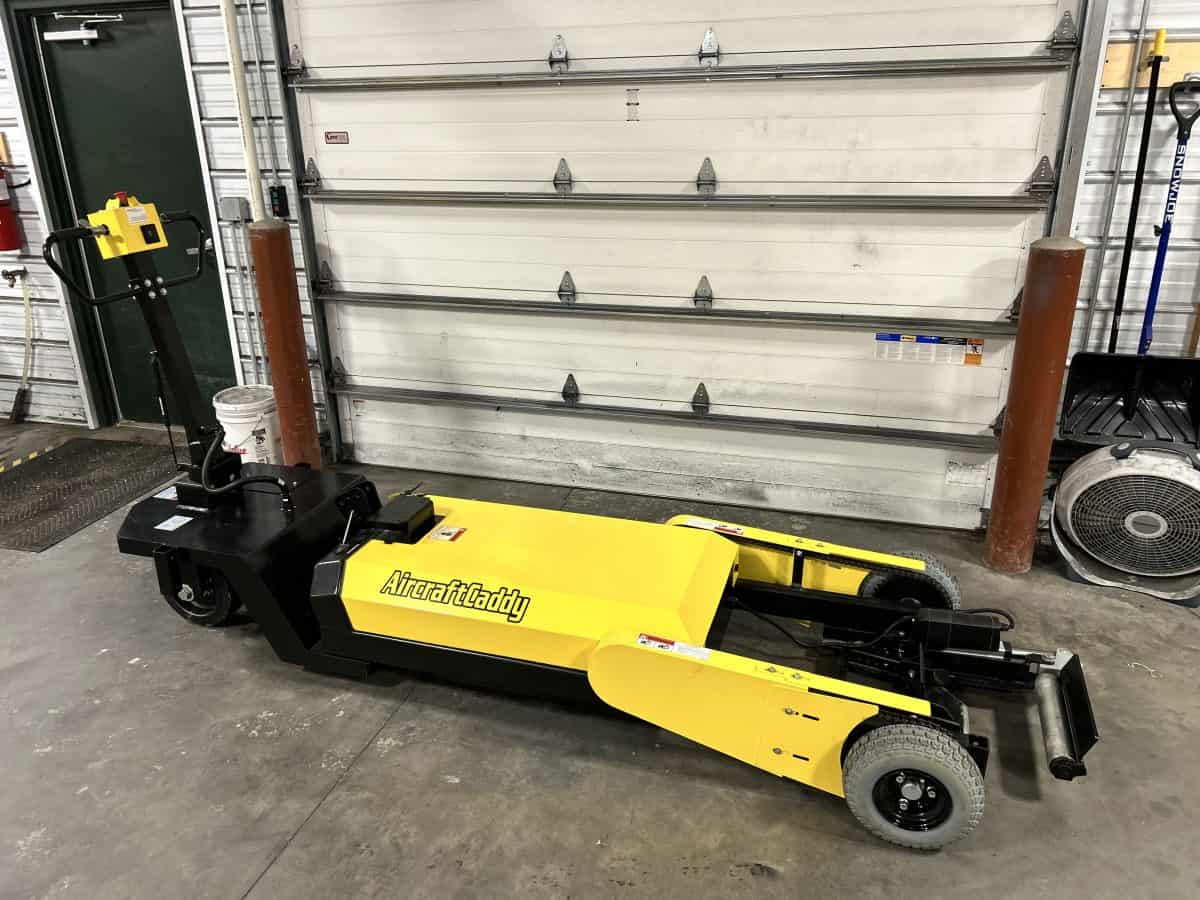
Explore the AircraftCaddy range and request information.

Aircraft Caddy 15K Magic Arm for Safe Aircraft Moves

Tight hangars leave no room for hesitation. When clearance is limited, the right tug can make the difference between a smooth move and unnecessary stress. The Aircraft Caddy 15K Magic Arm gives one operator a safer, easier way to load and maneuver aircraft up to 15,000 lbs in tight spaces, hangars, and ramp staging areas.

Why the Aircraft Caddy 15K Magic Arm stands out

The strength of this unit is not just its pulling power. It is the way it improves control at every step of the move. The Magic Arm uses an electric actuator to power load the aircraft, helping reduce manual effort while giving the operator a more controlled way to position and move the aircraft.

  • One operator can safely load and maneuver aircraft up to 15,000 lbs.
  • Powered loading helps reduce manual effort during aircraft positioning.
  • Variable speed control, neutral throttle braking, and adjustable acceleration and braking support smoother starts and stops.
  • Quiet electric operation helps the operator stay more aware of the aircraft and surrounding space.

Built for precise aircraft movement

The Aircraft Caddy 15K Magic Arm is engineered for steady, predictable handling. It combines a heavy-duty steel frame, 36VDC drive system, 2:1 gear reduction, variable speed twist grip control, and 0 to 2 mph forward and reverse travel to help the operator move with precision instead of rushing the job.

That precision carries into the safety side of operation as well. When the unit powers on, the controller runs internal diagnostics. If the handlebars are out of neutral, the tug will not respond until they return to neutral. When the operator releases the handlebars, the unit comes to a quick but smooth stop and holds position with an electric brake.

Built for day-to-day use

This is a commercial-use machine designed for repeat aircraft handling. It runs on a three-battery 36V system, delivers nominal power of 1 hp with 2 hp peak, and provides maximum drawbar pull of 800 lbs. It also includes an onboard charger and battery discharge indicator to support daily use.

A full charge provides about eight hours of runtime, and the charger automatically shuts off when the batteries are fully charged. That makes the Aircraft Caddy 15K Magic Arm practical for daily operations without adding unnecessary complication.

Why it is a smart buy

Buying the Aircraft Caddy 15K Magic Arm means buying better control. For teams that move aircraft regularly, that means a more consistent way to handle valuable aircraft with less manual strain and more confidence.

  • It helps reduce the labor needed to move aircraft in tight spaces.
  • It gives operators more precise low-speed control during loading, maneuvering, and final placement.
  • It supports safer movement with startup diagnostics, neutral-position protection, and controlled electric braking.
  • It is built for commercial use, not occasional convenience.

Options that help match the job

The Aircraft Caddy 15K Magic Arm can be configured to better fit demanding environments. Available options include a nine-tooth gear option for heavier planes, inclines, or bumps that increases torque by 2.5x while reducing speed, along with manual or electric winch options, a safety stop switch, molded handlebar, virtual training, and a lithium battery option.

A practical fit note

Before buying, it is smart to confirm the aircraft nose wheel setup and turning limits. The Magic Arm configuration can interfere with wheel pants, and turning radius is limited by the aircraft’s nose gear turning limits.

Ready to move aircraft with more control?

Talk with DJ Products about the right Aircraft Caddy 15K Magic Arm setup for your aircraft and operating environment. Because towing capacity can vary based on surface conditions, load weight, wheel type, and other application details, a quick review helps match the right power and option package from day one. Call 800-686-2651 to get started.

Get a quote on the Aircraft Caddy 15K Magic Arm and spec the right unit for your operation today.

The AircraftCaddy 8K Magic Arm: Stop Wrestling Airplanes in Tight Hangars

The problem nobody brags about

Moving an aircraft a “few feet” is never just a few feet.

It turns into a slow-motion shuffle, two people pushing in awkward angles, hoping the tow bar does not slip, and praying the wingtip clears that one post you forgot was there.

Hangars are tight. Ramps get busy. Labor is expensive. So the question becomes simple: how do you move aircraft safely and efficiently without turning every reposition into a production?

The solution: one person, battery power, real control

The AircraftCaddy 8K Magic Arm is a battery-powered AircraftCaddy designed to help one person load and maneuver aircraft up to 8,000 lbs in and out of tight spaces, hangars, or for staging on the ramp.

This is not about showing off gear. It is about getting aircraft positioned faster, with fewer hands, and with less “hangar gymnastics.”

Why the Magic Arm 8K makes money

How many headaches and labor hours does this remove from your week?

Here is where the ROI usually shows up:

1) Fewer people tied up per move

When one operator can handle routine positioning, your second person stays on higher-value work (fueling, cleaning, line service, maintenance support, customer turnarounds).

2) Faster hangar flow and ramp staging

If you manage multiple aircraft, small delays stack up. Tight control and predictable movement helps you keep the hangar flowing and the ramp less congested.

3) Less stress in close quarters

Tight spaces punish sloppy movement. The Magic Arm 8K is built around controlled maneuvering, not “hope and shove.”

What operators like about the way it drives

The Magic Arm 8K is built with practical features that matter in real hangars:

  • Heavy duty steel frame

  • 3/4 HP, 36VDC drive system with 2:1 gear reduction and chain drive to the tires

  • Variable speed twist grip with 0 to 2 mph forward and reverse

  • Neutral throttle braking plus adjustable acceleration and braking

  • Battery discharge indicator and onboard charger

For key safety and control behavior, when the handlebars return to neutral, the unit comes to a quick, smooth stop and holds position with an electric brake style response. That matters when you are inches from a wall, a tool cart, or another aircraft.

Battery life that fits a full workday rhythm

  • About 8 hours of runtime when fully charged

  • About 8 hours to recharge after full discharge

  • The charger includes an automatic timer shutoff when batteries reach full charge

Translation: it is built around a practical shift-style workflow. Run it, plug it in, repeat.

Options that unlock more capability (and better fit)

No two operations are identical. That is why the Magic Arm 8K includes a strong list of add-ons depending on your aircraft mix, surface conditions, and how aggressive your repositioning needs are:

  • Nine tooth gear option for heavier planes, inclines, bumps. It increases torque by 2.5x and reduces overall speed

  • Winch options (manual or electric) for the setup you prefer

  • Foam-filled tires for shops that hate flats

  • Virtual Training to get operators confident quickly

  • Lithium Battery Option (contact us) for shops that want longer runtime and modern battery benefits

Fit check: two important notes before you buy

This is the part that saves everyone time.

The manual calls out two real-world constraints:

  1. Wheel pants can interfere. The Magic Arm 8K can power load your aircraft with an electric actuator, but it may not work if the aircraft nose wheel has wheel pants due to interference.

  2. Turning radius depends on the aircraft nose gear limits. The tug cannot magically exceed the aircraft’s steering geometry.

If your operation includes mixed aircraft types, this is exactly why a quick configuration call matters.

Pricing (for budget planning)

The standard unit pricing is $7,251.

Options vary based on how you configure the unit for your aircraft and surface conditions.

A simple payback mindset (no spreadsheets required)

Use this quick back-of-the-napkin method:

  1. Count how many aircraft moves you do per week (hangar in/out, staging, repositioning, maintenance shuffles).

  2. Estimate average time per move today.

  3. Multiply by how many people are typically involved.

  4. Multiply by your loaded labor rate.

Even shaving minutes off repeated moves can add up fast when the work is weekly and predictable.

Bottom line

If you are tired of tying up two people for routine aircraft positioning, the AircraftCaddy 8K Magic Arm is built to turn aircraft moves into a controlled, one-operator task, even in tight hangars and busy ramp environments.

Get the right configuration for your aircraft

Call 800-686-2651 or reach out with your aircraft make/model and nose wheel setup so we can match the best configuration and options.

Discover the Ease of Aircraft Handling with the AircraftCaddy

Hey there, aviation enthusiasts! If you’ve ever found yourself struggling to move your aircraft around, you’re in for a treat. Let’s chat about the AircraftCaddy from DJ Products and how it can make your life a whole lot easier.

What Exactly is the AircraftCaddy?

Imagine having a trusty sidekick that helps you move your aircraft effortlessly. That’s what the AircraftCaddy is all about. It’s a battery-powered tug designed to handle aircraft of various sizes. Whether you have a small private plane or something a bit larger, there’s an AircraftCaddy model that fits your needs perfectly.

Why You’ll Love It

Versatility

The AircraftCaddy can handle planes with or without wheel pants, making it super versatile for different types of aircraft.

User-Friendly

With its twist grip variable speed control and ergonomic design, maneuvering your plane becomes a breeze, even in tight spots.

Safety First

The walk-behind design gives you better control, which means fewer accidents and a safer environment.

Built to Last

Made with a heavy-duty steel frame, this tug is designed to withstand the daily grind.

Which Model is Right for You?

AircraftCaddy 8K

It can handle planes up to 8,000 lbs and works great on various surfaces like grass and gravel.

AircraftCaddy 4K

Perfect for smaller aircraft, this model is ideal for planes up to 4,000 lbs. Its compact size makes it easy for one person to operate.

Hear from Happy Customers

Don’t just take my word for it. Here’s what some users have to say:

“I’ve had my AircraftCaddy 4K Jr. for 3 years. It has been 100% reliable and has taken all the work out of moving my airplane.”

“The AircraftCaddy works great! I’m really impressed by the quality and service I’ve received from DJ Products.”

Why DJ Products?

DJ Products is all about providing innovative solutions for material handling. We focus on quality and customer satisfaction, ensuring each AircraftCaddy is built to the highest standards. Curious to learn more? Check out our Aircraft Moving Solutions and see how the AircraftCaddy can transform your aircraft handling experience.

Ready to make your aircraft handling a breeze? Contact us for more details and to get your hands on one.

Solving Aviation Challenges with an AircraftCaddy

In the world of aviation, efficiency, safety, and precision are paramount. Our AircraftCaddy is designed to address a range of pain points that aircraft owners face on a daily basis. Here’s how the AircraftCaddy can transform your aircraft handling experience:

Maneuverability in Tight Spaces

One of the most significant challenges in aircraft handling is maneuvering in confined hangar spaces. Traditional methods often require extensive space and can be cumbersome. The AircraftCaddy excels with its tight turning radius, allowing for precise movements even in the most restricted areas. This feature is particularly beneficial for hangars where space is at a premium, ensuring that aircraft can be positioned accurately without the risk of damage.

Reduced Physical Effort

Moving aircraft manually or with traditional equipment can be physically demanding and pose a risk of injury. The AircraftCaddy is designed to minimize physical strain on operators. Its ergonomic design and user-friendly controls make aircraft handling a safer and more comfortable task, reducing the likelihood of strain-related injuries.

Enhanced Safety Features

Safety is a top priority in aviation operations. The AircraftCaddy is equipped with essential safety features, such as emergency stop buttons, which allow operators to halt movement immediately in case of unforeseen circumstances. This ensures a higher level of protection for both the operator and the aircraft, reinforcing a safe working environment.

Operational Efficiency

Time is critical in aviation, and efficient aircraft movement is essential for maintaining schedules and productivity. The AircraftCaddy enhances operational efficiency by allowing quick and effortless positioning of aircraft. This streamlined process saves valuable time and improves overall workflow.

Versatility and Adaptability

The AircraftCaddy is versatile enough to handle various aircraft types and sizes, making it suitable for individual owners, Fixed Base Operators (FBOs), and other operations. It can manage aircraft weighing up to 35,000 lbs., providing a reliable solution for a wide range of towing applications.

Cost-Effectiveness

Investing in an AircraftCaddy can lead to long-term cost savings. Its durable construction and efficient operation reduce the need for frequent repairs and replacements. Additionally, the ability to maneuver aircraft precisely helps prevent accidental damage, further lowering maintenance costs.

Improved User Experience

Our customers’ feedback highlights the AircraftCaddy’s ease of use and reliability. Operators appreciate the smooth throttle control, balanced handling, and the ability to leave the caddy hooked up to the aircraft, which simplifies the process of closing hangar doors and accessing the aircraft. This user-friendly experience enhances overall satisfaction and operational efficiency.

By addressing these pain points, the AircraftCaddy stands out as an indispensable tool for aviation professionals. Its combination of precision, safety, and efficiency makes it a valuable asset in any hangar or airfield. Contact us for additional information.

AircraftCaddy Easily Maneuvers Planes in Tight Hangars

When looking for a new aircraft tugger to move Pilatus PC-24 and PC-12NG planes, Andrew Ambrose came across DJ Products and our AircraftCaddy line.

Although Ambrose didn’t mind how they were previously moving their planes (with a tractor and tow bar), the others that needed to move the planes weren’t a fan of it due to the double pivot point aspect. Along with that, the tractor was a little light for the job.

Finding out about our AircraftCaddy was pretty easy for Ambrose, since his hanger neighbor already had one of our units.

When it came to finding the right AircraftCaddy unit for these planes, our Sales Engineer, Stacy Sobiech, was able to find a great solution to solve all of Ambrose’s pain points. With 18,000 lb. max weight, 5 blade propeller, and tight hangar space, the best fit for Ambrose was our AircraftCaddy 35K with 5 Blade Pilatus/TBM Steering Arm Weldment and lazy-susan turning mechanism to better maneuver and adjust his planes in his hangar.

Aside from the AircraftCaddy being a great fit for their application, another reason Ambrose chose to work with DJ Products to find his unit was the price! We offer a sturdy, long-lasting machine that pays for itself. Whether you’re looking for convenience, safety, or durability, choosing an AircraftCaddy to move your aircraft will save you in a long run.

On to the good stuff: how well did it work? According to Ambrose, “It’s easier to use than I expected, honestly. With the plane loaded, it’s very balanced and super easy to maneuver. The throttle handle setup is great, very smooth and easy to regulate the power. Forward to reverse transition is super smooth with no slop. LOTS of power and traction. We are in a tight hangar and this caddy makes it so easy to hit your marks the first time. You can be very accurate with aircraft placement, which is a huge plus.”

But it doesn’t stop there. The biggest benefit for them was the size of the caddy. Unlike when they used the tractor and tow bar, they’re able to leave the AircraftCaddy hooked up to their plane and close the door. Prior to receiving their unit, they would need to unhook everything just to close the hangar. This makes the process much more efficient when accessing their aircraft.

One part that we are especially proud of is the experience Ambrose had while working with our team. Initially working with Sobiech, he had an “excellent” experience, with “fast responses every time.” Even after he purchased his unit, our Service team helped him quickly get a wider platform to better accommodate the wide tire on the jet.

All in all, Ambrose said, “I would absolutely recommend this tug from my current experience.”

We’re thrilled to be able to provide not only high-quality, long-lasting products, but also top-notch customer service to all of our customers.

Pilots Love the Maneuverability of the AircraftCaddy 4K/8K

Pilots Love the Maneuverability of the AircraftCaddy 4K/8K

Planes glide smoothly through the air, but on the ground it’s a whole other story. Moving aircraft in and out of hangars is a difficult and tedious job. Lighten the load with the AircraftCaddy, a battery-powered aircraft tug from DJ Products.

AircraftCaddy: Solution to Every Pilot’s Problem

How many employees does it take to move aircraft around an airfield? Not only do you need to keep a minimum number of people on hand for this task, but you incur additional costs if they become injured and you have to replace them.

Thanks to the AircraftCaddy, a single person can comfortably move small aircraft weighing up to 4,000 pounds. This frees up the rest of your staff to attend to other workday tasks while reducing the risk of injury from muscle or joint strain.

Much of the activity on an airfield takes place outdoors. Our aircraft tug is sturdy enough to function on a number of different surfaces, up and down inclines and during inclement weather.

Customers Sing the Praises of the AircraftCaddy

Don’t just take our word for it. Here are comments from one of our many satisfied customers, who spoke with DJ Products Sales Specialist Karl Koznick:

“Just ran the tug in and out of hangar with my Baron attached… very smooth, easy to maneuver and simple! Overall, very pleased with the caddy! Whoever designed it should be given kudos!”

Top AircraftCaddy Features

With these great features, it’s no surprise that the AircraftCaddy is so efficient and cost-effective:

* The AircraftCaddy is powered by three 12-volt batteries, making it eco-friendly and low maintenance.

* A high-tech speed controller and neutral throttle braking make operating the pusher simple for anyone.

* The AircraftCaddy’s ergonomic design reduces the chance of chronic injuries from repetitive motions.

* For the ultimate in convenience, add an optional remote control that allows you to move your aircraft at the touch of a button.

Want to Learn More About Our Aircraft Tug?

Our friendly and knowledgeable Sales Engineers are ready to help you choose the right product for your specific needs. Call 800.686.2651 or use our online chat feature for more information.