
Got Power Movers for Industrial Uses? Get Electric Carts for Your Office, Too

At DJ Products, we make a number of material handling solutions that are used in warehouses, hospitals, hotels and a number of other workplaces where workers need to transport heavy loads. And if you are already using our products in these areas, then you know that our power movers and trailer movers eliminate the pain and strain of manually pulling and pushing a heavy cart and wheeled equipment and are also less costly, smaller, and more maneuverable than traditional powered equipment.

But have you also considered using a simple electric cart for other areas of your enterprise? People in your offices may have need of an electric cart for transporting office supplies—boxes of paper, printer cartridges, samples for demonstrations, food orders for group meetings, and presentation materials such as projectors.

Just as you do not want the staff on the industrial side of things becoming strained, you also do not want your office staff hurting themselves either. There is a temptation for people in offices to think that they can just carry heavy loads on their own since they are not doing the kind of heavy lifting that warehouse workers do on a regular basis. They may not have an appreciation for the kind of musculoskeletal strain that carrying a cumbersome load ‘just this once’ can produce.

You and your busy staff will appreciate how our electric cart arrives charged and requires no assembly, so you can put it to use right away. In fact once you have an electric cart for use in the office, you will wonder how you managed without it.

Logistics Industry Down But Not Out

Considering the state of the economy, it’s not unexpected that the logistics industry is suffering along with everyone else. According to the recently released Global Contract Logistics 2009 report published by Transport Intelligence, the global contract logistics market grew at a rate of 5% in 2008, half the 10% growth experienced in each of the past few years. Of greatest concern was the noticeable drop in volume during the fourth quarter, generally considered the industry’s peak season.

“This downturn has been felt well into 2009, although there are signs that the fall in volumes may well have bottomed out by the end of the first quarter, the report suggests,” logistics industry analyst Ken Hurst noted in today’s posting on Works Management online.

Increasing, global reach provides the greatest opportunity for future success in the logistics industry, particularly when U.S. markets go stale. Developing markets in Latin America, Central and Eastern Europe and the Asian Pacific region offer the most opportunity for future growth, according to the Ti report. While the China market has cooled recently, Hurst expects it to rebound, saying, “… with GDP growth still in the high single digits, and a $585 billion stimulus package taking effect, underlying economic activity will continue to drive its [China’s] logistics sector.”

The report predicts five more years of volatile swings in the logistics industry worldwide with significant recovery not predicted until 2011. Rebuilding is expected to be agonizingly slow. According to Hurst’s post, “Ti believes that the market will grow at a compound annual rate of 2.4% between 2009 and 2012.” Stabilization of the industry will depend on the speed with which global sales increase. Until consumer confidence returns and drives up demand for goods, manufacturers and retailers will continue to keep supply costs lean. Because of its position at the tail end of the supply chain, the logistics industry may be one of the final economic sectors to achieve recovery. While contractual relationships will protect some logistics companies from the worst market volatility, “logistics providers will have to work hard at increasing their value proposition to clients if they are to avoid the worst excesses of the recession,” John Manners-Bell, Ti CEO told Hurst.

Overseas Jobs Could Be Headed Back to America

The tide could be turning. Following up on a campaign promise to stop the flow of manufacturing jobs overseas, President Obama has proposed closing loop holes in the U.S. tax code and raising corporate taxes on offshore earnings to encourage U.S. manufacturers to keep jobs in America. The President is pressuring Congress to eliminate certain tax breaks that he says encourage U.S. companies to move jobs overseas. At the same time, the President’s recently-released budget initiative proposes to increase corporate taxes on overseas earnings.

Proponents say the President’s plan would not only keep more jobs in America, it would raise more than $100 billion in much needed revenue over the next decade. Current tax laws allow U.S. firms to defer taxes on overseas profits if they invest those profits in their foreign subsidiaries. Critics say that practice encourages businesses to fund their foreign operations at the expense of those located on U.S. soil. And, of course, there’s considerable debate on both sides about what the amount of the tax rate should be if the rules are changed. Many consider the current 35% rate (which few actually pay) unsustainable, particularly in the current economy. Some industry experts have suggested a more realistic 15% to 20% tax rate. The debate is expected to be energetic. If your company has a global reach, you might want to weigh in with your Congressional representatives.

Any move to keep U.S. jobs on U.S. soil will be a positive one for America’s manufacturing industry, American workers, and the U.S. economy. Hard-hit by the economic recession and the problems of Detroit’s Big Three auto manufacturers, the future of U.S. manufacturing has been painted as bleak by many. But the real story is much more complex and, fortunately, rosier. While U.S. manufacturing jobs have moved overseas, particularly to China, to take advantage of lower labor costs; over the past 15 years, the number of Chinese manufacturing jobs has not increased, leading industry experts to believe we’re on the downslope of the outsourcing peak, at least with regards to China. In fact, according to the Material Handling Industry of America, the percentage of workers employed in manufacturing is higher in the U.S. than it is in China. Good news for U.S. workers.

More on Friday

U.S. Manufacturing Not Dead Yet

Despite dire reports that U.S. manufacturing is dying, the old boy still seems to be alive and kicking.

  • Sure the recession has U.S. manufacturers flailing, and the failure of the Big Three automakers is a definite blow to the country’s manufacturing power; but it’s far from the death knell some have predicted.
  • Sure global recession has decreased domestic and foreign demand, but faith in history tells us that’s a temporary problem. The turnaround may not materialize as quickly as we’d like, but demand will increase; it always does.
  • Sure manufacturing employment figures are declining, but statistics don’t tell the whole store. The decrease is due in part to improved manufacturing efficiency and automation, not merely the effects of decreased supply and demand in a recessionary economy.

The most important clue that there’s still plenty of life left yet in U.S. manufacturing is that increased efficiency.

U.S. manufacturers have been able to harness technology to produce goods more efficiently with fewer workers, making marked gains in productivity in the process. This increased productivity will make it more attractive for manufacturers to bring manufacturing operations and jobs back to U.S. soil (see our May 13 post). It’s a move the Obama administration is poised to encourage by closing tax loopholes that the President believes have exacerbated the outsourcing of American manufacturing jobs overseas.

The climate is right for such a show of faith by manufacturers. Americans are clamoring to have American goods produced on American soil by American workers. Legions of Americans are making a point to Buy American and eschew foreign-made products and the businesses that sell them. For the first time in decades, U.S. workers, pushed by the Detroit reality, are showing a willingness to scale back their demands and work with manufacturers to make American salaries more competitive in the global market. The economy is tightening up competition, weeding out the weak players and giving the strong a more open playing field. Real estate is cheap and opportunities to purchase near turn-key operations abound for savvy shoppers.

Taken together, the time is ripe to bring U.S. manufacturing — and jobs — back home. U.S. companies that are able to take advantage of the current climate and move jobs back to the U.S. stand to reap untoward benefits in public relations and worker and customer loyalty.

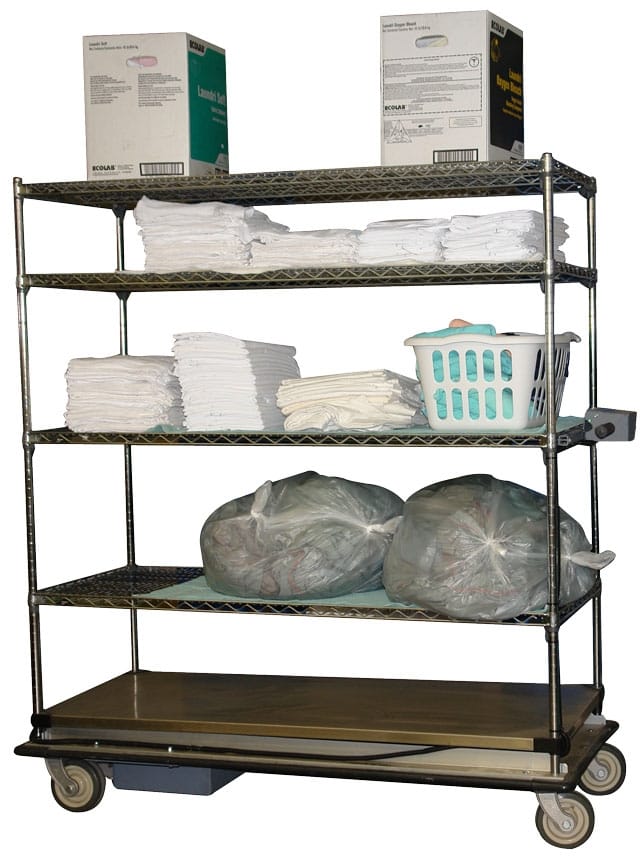
New Motorized Clean Linen Wire Cart eliminates strains and pains from pushing heavy clean linen and supply carts in hospitals, hotels, resorts, and casinos.

DJ Products, Inc. of Minneapolis has introduced a motorized clean linen wire cart that transports clean linens used for housekeeping in the hospital and hospitality industry. The Motorized Linen Cart eliminates the manual pushing of heavy clean linen carts, especially where carpeting makes them difficult to push. The powered cart is motorized for moving clean linens used for daily duties in hospitality and hospital environments.Motorized Linen Cart

Continue reading “New Motorized Clean Linen Wire Cart eliminates strains and pains from pushing heavy clean linen and supply carts in hospitals, hotels, resorts, and casinos.”

New small electric aircraft tug pulls up to 35,000 lbs.

DJ Products, Inc. is the world’s leader in providing battery-powered carts and a cart tug to the manufacturing, hospital, retail and aircraft industries.  They provide solutions that eliminate the strains and pains associated with manually pushing heavy carts and wheeled equipment, or are less costly, smaller, and more maneuverable than traditional equipment like forklifts and pallet jacks which are not designed to push/pull wheeled carts and equipment.AircraftCaddy 4K Jr. Airplane Tug

Continue reading “New small electric aircraft tug pulls up to 35,000 lbs.”

How Ergonomics Mitigates Force

Horizontal push force is a more significant factor than load weight in pushing and pulling tasks. In moving a wheeled piece of equipment or a load on a wheeled cart, three main forces come into play:

  • Starting or initial force is the effort required to initiate movement. It requires the greatest effort because it must overcome inertia.
  • Sustained or rolling force is the effort required to keep the load in motion and requires significantly less effort if a steady speed is maintained.
  • Turning force is the effort required to turn the load and can be significant as the load is moved into a new direction, often requiring asymmetric body postures and muscle exertion which carry a greater risk of injury.
  • Stopping or positioning force is the effort required to bring the load to a halt or position it in a specific place. Positioning can require significant, multidirectional force, exposing the worker to hazardous postures and muscle exertions.

Ergonomics mitigates these forces through design that seeks to minimize stress on the worker’s body and reduce wasted movement and effort. By reducing unnecessary movements and awkward postures, the force exerted by a worker is more efficiently utilized, thus reducing the amount of force necessary to move a load. This reduces both the time and effort needed to complete a task and the risk of worker injury. To ensure that equipment can be easily used by all members of the workforce, ergonomic design is often adjustable to fit a greater number of workers or is targeted to accommodate the weakest members of the workforce.

Ergonomics works to reduce inertial and dynamic forces, friction and physical interference to decrease the amount of force required to move a load. Considerations in ergonomic design generally include:

  • Floor materials, pitch and slope
  • Load weight, type and quantity per shift
  • Cart or equipment size, weight and design
  • Wheel or caster type, construction, materials, number and placement
  • Handhold type, height, width and placement
  • Control type and placement
  • Route, number of turns, obstacles and amount and type of maneuvering
  • Frequency, duration and repetition of task
  • Body postures required to operate equipment and perform tasks
  • Height, weight, strength and gender of typical worker

Pushing vs Pulling Manual Carts

Pushing and pulling are the two most frequent actions workers execute in the course of doing their jobs. So in maneuvering manual carts, which is easier for the worker and creates less risk of injury — pushing or pulling?

Experts say pushing is preferable to pulling for a number of reasons. Research has demonstrated that people are able to exert higher push forces than pull forces. Given that horizontal push force, not the weight of the load or equipment, is the most significant factor in determining the effort required to move a load, that’s a significant consideration in selecting equipment.

Think of what happens to the body when you push something. Your entire body is used to create push force. In pushing an object, your body is more centered which allows you to concentrate force. Limbs are generally held closer to the body, limiting the possibility of extension injuries.

Pulling on the other hand, creates tremendous stress on individual body parts. When you pull an object and you are facing the direction of travel, one arm is stretched behind your body. This places the shoulder and back in awkward postures, increasing the potential for painful injury through overextension or awkward twisting. If you use two hands to pull an object you must have your back to the direction of travel. Walking backwards without a clear view of your path is an invitation to an accident. On an incline momentum can increase unexpectedly and the cart can careen into the worker or “run over” his feet.

There are times when pulling is the only way to maneuver a manual cart into the proper position, but at all other times pulling should be avoided. Pushing is the safer, more ergonomic way to move a manual cart.

Handhold Design Can Improve Worker Efficiency

Most carts have handholds of one sort or another. Handles are such an ordinary part of everyday equipment that it’s easy to ignore their importance in efficient equipment use. But handholds are the link between the operator and the load. Handholds cue the operator on how much force to exert and where to apply it most effectively to move the load. Handhold placement and design on carts can increase or decrease the ease and efficiency with which a worker moves a load.

In evaluating the usefulness of a cart, consider these important elements of handhold design:

  • Handhold Height. Handhold height defines the operator’s posture, and posture determines the amount of force a person is able to generate when moving a cart. Given the difference in human size, no single handhold height will be optimal for all workers. Handholds that cause operators to bend or stoop can lead to musculoskeletal injuries. When handholds are located at the proper height for an individual’s body, he is able to exert maximum force without straining his body. An adjustable handhold system will accommodate workers of various sizes. Other solutions include a continuous vertical handhold system that can be grasped at any point along its length or a series of handholds at varying heights.
  • Handhold Width. Handholds should allow the operator to grip the cart near its outer edge to provide maximum leverage for turning and positioning. However it’s important that hands, fingers or arms not protrude beyond the side of the cart to prevent crushing injuries should the cart come in contact with a wall or other equipment.
  • Handhold Type. The type of handhold can dramatically affect the amount of force an operator is able to exert when maneuvering a cart. Poor coupling, the contact between hands and equipment, can decrease the force an operator can exert by 65%. Handhold shape should not concentrate pressure on any specific area of the hand. There should be no sharp edges or pronounced ridges. Both the palm of the hand and the fingers should be able to contact the handhold which should be wide enough to accommodate the entire hand.
    Note: Pulling tasks require a handhold that can be gripped with the fingers wrapping around the handle. Pushing tasks need only a good surface that provides stable hand/equipment coupling.

Ergonomic Car Pusher = Savings for U.S. Auto Industry

As the already-battered U.S. auto industry struggles to keep its doors open during the growing economic recession, the financial and workforce value of ergonomic car pushers will become increasingly important. Doom and gloom seem to headline news about the auto industry.In a bid to prop up troubled domestic automakers, governors from six states heavily invested in the auto industry — Michigan, Ohio, Delaware, Kentucky, New York and South Dakota — petitioned the U.S. Treasury and Federal Reserve for help. “The auto industry; their network of suppliers, vendors, dealers and other businesses; and the communities that rely on those businesses face unimaginable challenges — challenges we urge you to help address,” the governors wrote.Over the past decade, U.S. automakers have been fighting a losing battle against tough competition from foreign car companies, particularly Honda and Toyota.  Faltering automakers General Motors and Chrysler are talking merger in order to stay alive, though financing could present a major stumbling block. Although tens of thousands of jobs would be lost in a merger, industry experts agree that a merger is preferable to the even greater disaster that would occur should either company collapse.But automakers aren’t the only ones feeling the pinch. U.S. auto dealers are also struggling; and particularly in areas glutted with dealers, many are being forced to scale back or close their doors. Nationally, new car sales are down 13% from last year, with sales expected to continue dropping as people cut expenses and harbor their cash during the impending recession. The National Automobile Dealers Association has asked President Bush to consider issuing refundable consumer tax credits for new car and truck purchases or instituting a program that would entice consumers to upgrade their vehicles.The bottom line is that all players in the auto industry, from monster auto makers to small-town dealers, are going to have to make their operations leaner and meaner. Turning to ergonomically-designed, fuel-smart car pushers specifically designed for the automotive industry can reap significant savings. Ergonomically-designed car pushers are proven to reduce expensive musculoskeletal injuries and their attendant medical, insurance and workers compensation costs. And ergonomic equipment allows a single worker to accomplish a greater workload, increasing production efficiency and reducing personnel costs. Battery and electric-powered car pushers also saves big bucks in fuel and maintenance costs compared to diesel or gas-powered car pushers. Studies show that ergonomic equipment pays for itself in a single year. After that, it’s all gravy!To find out how an ergonomic car pusher can improve your bottom line, talk to the experts at DJ Products.