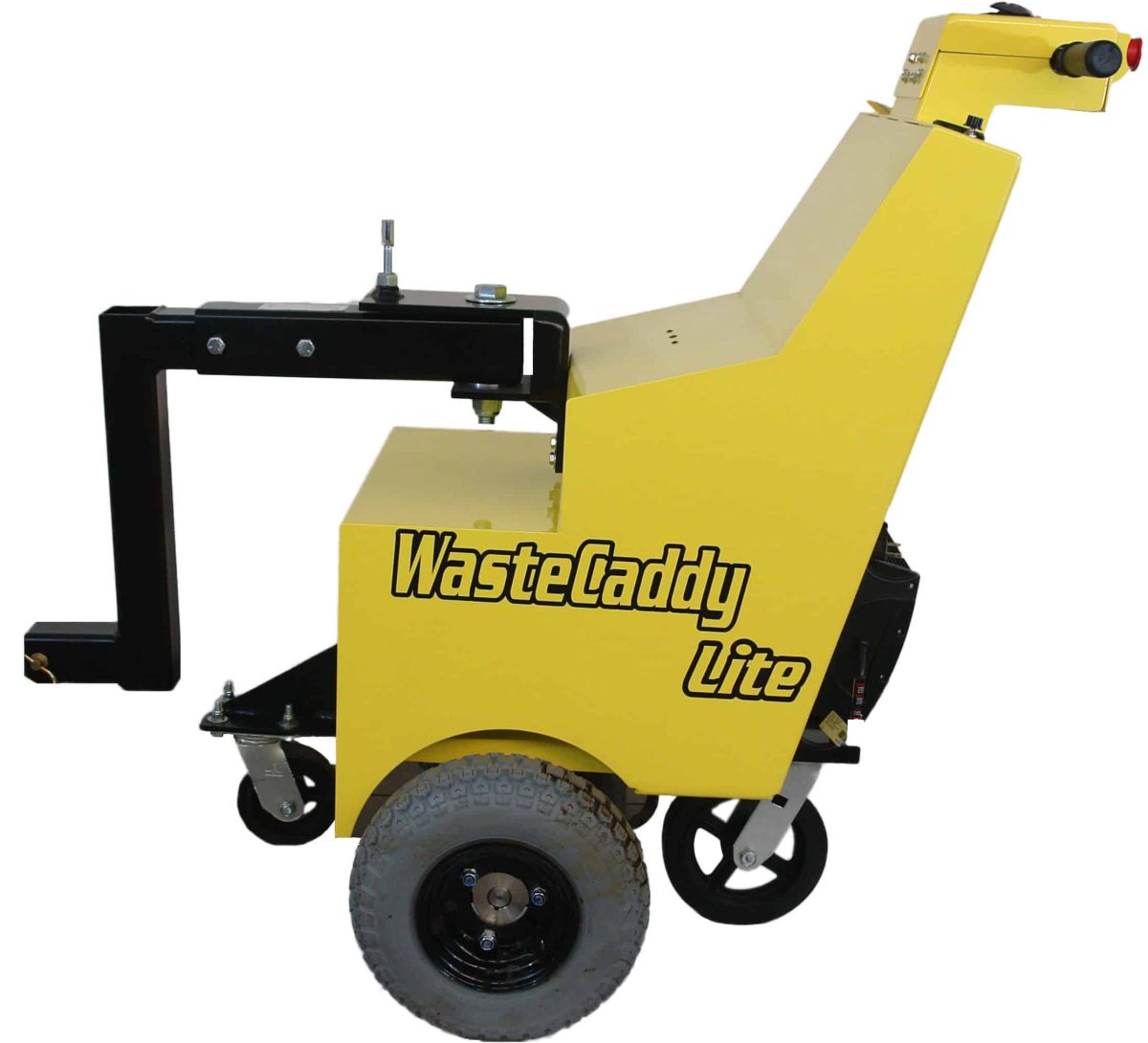
The WasteCaddy Dumpster Mover helps Doug Olson quickly and effortlessly transport heavy trash bins at Grand Central Flats in Columbia Heights, MN. Benefits:
Pushes full dumpsters up to 5,000 lbs. from trash room to curbside for pick-up
Works well on snow, sleet, and up inclines for outdoor or indoor applications
Reduces the risk of on-the-job injury and workers compensation claims
Watch the video below to hear Doug’s experience using the WasteCaddy. Contact a sales engineer at DJ Products to schedule your free demo: 800-686-2651.
Jack Somerville of Vertiv Corp. says his role for the past 10 years in advanced manufacturing engineering has been “To bring my company new technology to solve problems in manufacturing. During that time, we bought 5 CartCaddies to help us move larger, heavier items in our manufacturing facility.”
Jack knew from the beginning that specs and drawings of the attachment connection from CartCaddy to his carts were crucial–without them, moving components weighing 40,000 lbs. down the assembly line simply wasn’t going to work.
Moving components of this magnitude also required a different speed setting on the CartCaddies. Jack’s sales engineer, Jerry Ries, had a solution right away. “DJ Products quickly sent out a pendant that we could use to adjust the speed,” he said. “That helped us get it dialed into exactly what we needed to move our units safely and at the proper speed.”
Satisfied with DJ Products response and flexibility, Vertiv Corp. has ordered heavy cart movers for loads weighing in excess of 150,000 lbs.
Dana Hurst, Truck Manager for Green Willow Trucking and Andersen Dairy, in Battle Ground, WA, regularly moves 150-pound milk carts by hand from his truck to dairy coolers of the grocery stores.
It’s a strenuous job that requires multiple trips a day for all his drivers. So Dana decided to find a more ergonomic solution to manually pushing and pulling.
“A few of our drivers tested it, in fact,” Dana said. “At first they were skeptical, but after they used it a few times they liked it.”
The free onsite demo option allowed Dana to “try before you buy,” which helped him determine his crew needed a bigger CartCaddy model. They switched to the larger CartCaddy 5WP Cart Mover. Hurst and his drivers have enjoyed the new efficiency and time savings the CartCaddy delivers.
Vulcraft of NY chose CartCaddy Cart Pusher for its ergonomic benefits
Craig May, a production supervisor with Vulcraft of New York, remembers his days as a lead rigger in the plant, pushing 2-ton carts across concrete floors in 100-degree temps.
As a result of his own experience, he went looking for a solution to manual labor 2 years ago. He found CartCaddy. “We were able to go online and look at the videos and decide for ourselves which cart was going to work the best for us. After seeing the videos and talking to our Sales Engineer, Matt Schilling, we were confident that we made the right decision for our teammates’ ergonomics.”
The crew thanked him for CartCaddy, and he advises anyone considering a cart pusher, puller or mover: “If you care about the health and safety of your teammates, it’s a no brainer. They’re amazing.”
Warehouse managers are constantly searching for ways to improve productivity while keeping expenses low. One solution is our electric warehouse equipment, which reduces operating costs and frees up employees for other tasks.
While technology is the source of many options, one relatively low-tech product is making a splash in 2019. Companies are turning to rubber pallet bands as an effective alternative to costly and time-consuming pallet wrapping.
Small Change, Big Savings
Fastmile Logistics, a last-mile delivery service covering the Southeast United States, had a goal to reduce packaging and disposal costs. The specific target was plastic pallet wrap, which was running an average of $14,000 per year.
Fastmile’s search led them to rubber pallet bands, and in 2014 they began a test program in their Orlando warehouse. According to general manager Brad Ward, average annual product savings have been approximately $5,000.
Benefits of Rubber Pallet Bands
Ward explained the multiple benefits he and his employees discovered with the use of rubber pallet bands:
– Band application takes a single employee a matter of mere seconds, compared to other methods which require at least two workers.
– The bands automatically snap into place without damaging the product.
– In addition to product and labor costs, use of rubber pallet bands results in lower trash costs. Ward estimated their warehouse saves at least $200 each year.
– Based on product mix, outgoing loads almost always had to be unwrapped and rewrapped, causing a significant drain on time. Wrapping products with rubber pallet bands has eliminated this inefficiency.
The global supply chain already relies on smart technology to speed up distribution, reduce paperwork, and allow customers and vendors to track shipments. Next up, the Internet of Things for logistics is reducing costs by improving tracking and data.
Some retailers are moving closer to on-demand manufacturing. Others are reducing wait times and stagnant inventory by taking advantage of the smallest details, like using yard trucks to prepare trailers to go out even before customers have actually placed the order.
How IoT Affects Logistics
Traditionally, supply chain logistics has been about making the best of push-based systems that require manufacturing parts or products months or years before a product will ever be sold. Missing data and guesstimation lead to high costs.
Connected devices provide better data that makes several cost-cutting and efficiency goals attainable:
– Pull-based ordering and manufacturing
– Solving understock and overstock issues
– Analytics to predict customer demand
– Identify slow parts of the supply chain
– Map inventory from raw materials to delivery
Examples of Supply Chain IoT
Smart devices for the supply chain range from simple products like RFID and GPS sensors to more advanced robotics. The data you collect is just as important for analytics as it is for on-the-ground operations.
Once your supply chain is on the Internet of Things, you can enact measures for better operational efficiency at the warehouse. It’s all about getting things out the door on time – not a moment too soon or too late.
Electric yard trucks allow workers to park trailers at the dock and maneuver them around the lot for immediate pick-up. DJ Products makes powered trailer dollies like the TrailerCaddy yard trucks that any employee can use, even without a CDL.
Could your LSA aircraft caddy soon be toting heavier planes? As the industry approaches its 15th birthday, the Light Aircraft Manufacturers Association (LAMA) and its partner the U.S. Ultralight Association (USUA) have been pushing to improve opportunities for the Light Sport Aircraft (LSA) manufacturing industry and individuals who own and operate light sport aircraft. What’s on the agenda?
Four Core Goals
After 4-years of effort, LAMA narrowed down its long list of industry suggestions to four goals in efforts to advance the industry. These were presented to high-level Federal Aviation Administration (FAA) executives, and ALL will be included in the FAA’s upcoming regulation plans:
1. Allowing special Light-Sport Aircraft to perform aerial work in addition to towing and flight instruction.
2. Introducing the safety and performance benefits provided by single-lever adjustable propellers.
3. Permitting electric propulsion and instruction in aircraft designed for such motors.
4. Solving issues surrounding modern gyroplanes, in that they may only be built as kits, making commercial training impossible.
In addition, the FAA also agreed to look into increasing the gross weight of LSA.
Changes on the Horizon
Though LAMA is hopeful, it’s important to emphasize each of these items is on the FAA’s list for eventual rule making. Eventual being the operative word. Rulemaking could take 3-years and the time it takes for them to go into effect could be far longer, assuming no changes of course.
In the meantime, LAMA has proposed a plan to get the FAA the data they need to speed the process. This will also provide opportunities under controlled circumstances for pilots to gain more rapid access to these new opportunities.
Pushing for change? Improve maneuverability with an aircraft caddy from DJ Products today.
Labor costs comprise the largest and most unpredictable element of warehouse operating expenses. Unlike material handling equipment and other fixed assets, staffing needs are dependent on variables such as fluctuating workloads and employee turnover.
When was the last time you made modifications in your warehouse layout? Are order pickers wasting a lot of time traveling from one slot to the next? Review the warehouse layout and look for ways to make workflows more efficient.
Consult an Expert
Outside consultants have experience working with all types of warehouse operations so they can provide tested solutions. Objective eyes can also spot problems and opportunities that may not be readily evident.
Automate Manual Processes
People are often reluctant to give up old-school methods, but when it comes to cost management, you have to use every tool at your disposal. Warehouse management systems (WMS) and other electronic data-gathering programs collect real-time data for more accurate and timely decisions.
Integrate Voice Logistics
Voice-driven systems have reached new levels of sophistication. Bluetooth headsets keep workers’ hands free for more efficient picking and other tasks.
Reduce Turnover
Hiring and training workers is a tremendous drain on the budget. In addition to direct costs associated with the process, it creates a ripple effect of indirect costs, including reduced productivity. Incentivize employees with bonuses, recognition programs and other perks for outstanding performance.
DJ Products: Your Top Source for Material Handling Equipment
Customers have proclaimed that using our electric material handling equipment is “like adding another employee.” Visit our website and learn how our assortment of tugs, movers and pushers can improve warehouse productivity and safety.
Robotics, in combination with warehouse equipment, has become a dynamic means of boosting productivity with lower costs. Exoskeleton robots are now poised to become the next big innovation in supply chain and logistics.
Could exoskeleton robots have an application in your warehouse operations? Here’s what you should know about this fascinating technology.
What Are Exoskeleton Robots?
Exoskeleton robots are wearable devices that incorporate electric motors, pneumatics and hydraulics to mimic or augment actual human movements. These devices afford a greater degree of strength and endurance than workers could achieve on their own.
Applications of exoskeleton robots cut across a wide range of fields, from manufacturing and supply chain to healthcare and military. As a result, the market is expected to reach an astonishing $2.8 billion by the year 2023, for a compound annual growth rate of 45.2 percent.
Advantages of Exoskeleton Robot Use
Muscle fatigue and overuse is a primary limitation in a number of activities. An exoskeleton robot lets the user remain functional and productive beyond the point at which they would normally have to stop.
Exoskeleton robots are currently incorporated extensively in two industries:
– Healthcare services use exoskeletons for injury rehabilitation to help muscles recover efficiently.
– The military uses exoskeletons in combat situations to reduce fatigue and injury risk among soldiers.
Full-body exoskeletons aren’t yet ready to be rolled out commercially, but upper- and lower-body exoskeletons have great potential as ergonomic aids for warehouse workers who perform repetitive tasks.
Make Safety a Priority with Ergonomically Designed Warehouse Equipment
Battery-powered warehouse equipment like our best-selling CartCaddyShorty includes features such as variable speed twist grips to prevent common repetitive motion injuries. Use our convenient online chat feature to learn more from our helpful sales engineers.
Weigh stations are used to calculate taxes on freight and also to ensure that trucks are below a maximum weight rating. In the U.S., trucks cannot weigh more than 80,000 pounds, and local areas may have lower limits.
Taxing by weight largely eliminates the need for time-consuming inspections. Our powered trailer mover can handle up to 100,000 pounds, but you’d better lighten the load before you drive up to the weigh station!
Truck Weigh Station Methods
Now, about how truck weigh stations work. It’s a lot different than a bathroom scale. Truck scales may be underground or inside of pads, but they all use one of these methods:
– Load-cell systems embedded with wires that sense a difference in electrical resistance depending on the weight
– Bending-plate systems that look like rubber or steel pads and have strain gauges inside
– Piezoelectric systems that use conductors to sense changes in voltage caused by the pressure above
Older technology requires the truck to stop several times with each axle on a scale, but it’s more common to see large scales that look like little landline strips and only require one stop.
As most drivers have noticed by now, there are also “weigh-in-motion” scales that don’t require truckers to stop. Simple versions are pads that truckers can slowly drive over, while more sophisticated technology allows for weigh-ins at freeway speeds.
Tow Trailers Up to 100,000 Pounds
Need a better solution for towing semi-trailers to the dock? DJ Products has beefed up our popular TrailerCaddy to operate as a powered trailer mover that can handle tank trailers, reefers, and even shipping containers.
Save time, improve safety, and avoid the high costs of shunting trucks with a powered trailer mover from DJ Products. Contact us for details.