
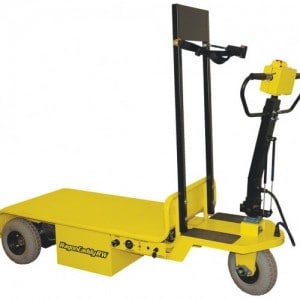
How Could YOU Use the Wagon Caddy Tow Tractor?

Wagon Caddy Tow Tractor
How could you use the Wagon Caddy Tow Tractor?

Of course an electric cart mover would benefit your warehouse by speeding up material handling — but it can also bring fundamental improvements to the way you operate. With our Wagon Caddy tow tractor, more of your employees can handle heavy loads. And they can move things easily through tight spaces anywhere in the warehouse. It opens up a ton of possibilities to get more done.

Make Picking and Stocking a Breeze

Moving up to 3000 lbs. at up to 5 mph, the Wagon Caddy tow tractor makes material handling easier and simpler. Whether a worker needs to move one small box or a heavy load of equipment, he or she can load it on the Wagon Caddy and hop on for the ride. Less walking, less carrying, and less strain — in other words, more productivity with fewer injuries.

Get More Out of All Your Employees

Not all your employees need to be strapping young men and women. Hire smart and reliable people and the Wagon Caddy lets you worry less about muscular strength and physical conditioning. Just about anyone can operate our electric cart movers.

Make Warehouse Logistics Easier

With maneuverable motorized carts for hauling materials around the warehouse, your logistics get easier. You can plan on easily moving heavy, awkward-to-carry items from point A to point B. Employees can even ride on the Wagon Caddy tow tractor and navigate through narrow spaces. Simply put, this electric cart automates and speeds up labor — and that productivity boost makes warehouse management easier.

Check out the versatile and powerful WagonCaddyR/W and call our Sales Engineers at 1-800-686-2651 for more info.


How Force Affects Pushing and Pulling Activities

Pushing and pulling tasks are among the most common industrial activities. Pallets of goods need to be moved from one point to another and equipment needs to be moved to a usage point. Workers at factories, hospitals, distribution centers, grocery stores and many other businesses engage in pushing and pulling activities numerous times a day. The Ergonomics of Manual Material Handling – Pushing and Pulling Tasks provides a useful overview of the costs and consequences of neglecting ergonomics in common industrial tasks that involve pushing and pulling. Click here to read the white paper published by Darcor, an industry leader in the design and manufacture of ergonomic casters and wheels, and Ergoweb, an ergonomic web resource.

While often taken for granted, wheeled carts and equipment are integral to the operation of nearly all manufacturing and distribution facilities as well as many businesses. Musculoskeletal disorders from pushing and pulling injuries cost American businesses billions of dollars each day in medical, insurance, disability and downtime costs. Ergonomically-designed carts, wheels and casters can significantly decrease the incidence of musculoskeletal disorders.

To be effective, ergonomic design for push/pull tasks must consider:

  • Human factors such as height, weight, age, gender, strength, posture and physiological capacity.
  • Task factors including distance moved, forces required to initiate and sustain movement, direction and nature of movement and task duration.
  • Cart/equipment factors such as size, weight, stability, caster/wheel specification and handhold type, height and orientation.
  • Floor/ground factors including surface characteristics, slope and contaminants.

Contrary to popular belief, horizontal push force is more significant than load weight in pushing and pulling tasks. Proper wheel or caster selection and equipment design can enable workers to move thousands of pounds safely and efficiently. Caster/wheel choice alone can reduce push force significantly. Rolling resistance refers to forces that resist movement and defines the amount of force a person must generate and apply to move wheeled equipment.

This force — called the starting or initial force by ergonomists — is always greatest at the start, just before movement begins. Fortunately, starting force must only be exerted briefly. Once acceleration is achieved, less force — called the sustained or rolling force — is required to maintain movement. The final major force that affects cart movement is turning force which can occur while the cart is in motion or during positioning.

Next time: How ergonomics mitigates force.

How Ergonomics Mitigates Force

Horizontal push force is a more significant factor than load weight in pushing and pulling tasks. In moving a wheeled piece of equipment or a load on a wheeled cart, three main forces come into play:

  • Starting or initial force is the effort required to initiate movement. It requires the greatest effort because it must overcome inertia.
  • Sustained or rolling force is the effort required to keep the load in motion and requires significantly less effort if a steady speed is maintained.
  • Turning force is the effort required to turn the load and can be significant as the load is moved into a new direction, often requiring asymmetric body postures and muscle exertion which carry a greater risk of injury.
  • Stopping or positioning force is the effort required to bring the load to a halt or position it in a specific place. Positioning can require significant, multidirectional force, exposing the worker to hazardous postures and muscle exertions.

Ergonomics mitigates these forces through design that seeks to minimize stress on the worker’s body and reduce wasted movement and effort. By reducing unnecessary movements and awkward postures, the force exerted by a worker is more efficiently utilized, thus reducing the amount of force necessary to move a load. This reduces both the time and effort needed to complete a task and the risk of worker injury. To ensure that equipment can be easily used by all members of the workforce, ergonomic design is often adjustable to fit a greater number of workers or is targeted to accommodate the weakest members of the workforce.

Ergonomics works to reduce inertial and dynamic forces, friction and physical interference to decrease the amount of force required to move a load. Considerations in ergonomic design generally include:

  • Floor materials, pitch and slope
  • Load weight, type and quantity per shift
  • Cart or equipment size, weight and design
  • Wheel or caster type, construction, materials, number and placement
  • Handhold type, height, width and placement
  • Control type and placement
  • Route, number of turns, obstacles and amount and type of maneuvering
  • Frequency, duration and repetition of task
  • Body postures required to operate equipment and perform tasks
  • Height, weight, strength and gender of typical worker

Pushing vs Pulling Manual Carts

Pushing and pulling are the two most frequent actions workers execute in the course of doing their jobs. So in maneuvering manual carts, which is easier for the worker and creates less risk of injury — pushing or pulling?

Experts say pushing is preferable to pulling for a number of reasons. Research has demonstrated that people are able to exert higher push forces than pull forces. Given that horizontal push force, not the weight of the load or equipment, is the most significant factor in determining the effort required to move a load, that’s a significant consideration in selecting equipment.

Think of what happens to the body when you push something. Your entire body is used to create push force. In pushing an object, your body is more centered which allows you to concentrate force. Limbs are generally held closer to the body, limiting the possibility of extension injuries.

Pulling on the other hand, creates tremendous stress on individual body parts. When you pull an object and you are facing the direction of travel, one arm is stretched behind your body. This places the shoulder and back in awkward postures, increasing the potential for painful injury through overextension or awkward twisting. If you use two hands to pull an object you must have your back to the direction of travel. Walking backwards without a clear view of your path is an invitation to an accident. On an incline momentum can increase unexpectedly and the cart can careen into the worker or “run over” his feet.

There are times when pulling is the only way to maneuver a manual cart into the proper position, but at all other times pulling should be avoided. Pushing is the safer, more ergonomic way to move a manual cart.

Mark Your Calendar: Upcoming Material Handling Shows

It’s spring and time for our industry’s annual material handling shows. Circle the date on your calendar and start making travel plans. Here’s the low-down on what’s planned:

MHIA  —  April 21-24  —  Cleveland, OH

The  Material Handling Industry of America will host its North American exposition, NA 08: Solutions that Make the Supply Chain Work, at the I-X Center in Cleveland, Ohio. Participants will have the opportunity to inspect and operate the latest manufacturing, distribution, material handling and IT solutions designed to increase supply chain productivity and profitability. Exhibits of products and services will be organized into four Solution Centers: manufacturing and assembly, fulfillment and delivery, information technology and knowledge which will showcase educational, benchmarking and research resources.

  • Sustainable, green solutions will receive special emphasis at the show. Andrew Winston, a nationally recognized expert on green business, will present the keynote address on Tuesday morning, April 22. The corporate environmental strategist will speak on Green to Gold: How Smart Companies Use Environmental Strategy to Innovate, Create Value and Build High Performance Supply Chains.
  • More than 70 education sessions will be offered addressing best practices, new equipment developments and leading trends.

MHEDA  —  May 3-7  —  Orlando, Florida

Accelerate in ’08 is the theme of the Material Handling Equipment Distributors Association 53rd annual convention and exhibitors’ showcase. The convention will be held at Loews Portofino Bay Hotel at Universal Orlando in the theme park capital of the world, Orlando, Florida. At the show the emphasis is on education and networking, with ample opportunities to explore new technology and trends, improve business knowledge and skills and network and socialize with material handling peers. Fun activities for spouses and kids are planned for those who want to make this a family affair.

  • An exciting variety of educational presentations, round tables and workshops are planned on innovation, business growth, leadership, sales, marketing, customer service, financial and people management. Among several dynamic speakers will be Brian Beaulieu, an economist with the Institute for Trend Research, speaking on Planning for Change and Steven Little, Senior Consultant with Inc. Magazine, who will speak on Growing Your Business in the 21st Century.
  • At the May 5 Exhibitors Showcase you can check out the latest trends and developments in material handling. Hundreds of manufacturers and consultants from around the world will be on hand to showcase and demonstrate their products and services.
  • A golf tournament and biking tour are among numerous optional tours available for the fun-seeking. Ticket discounts to area theme parks are also available.

Webcast: World-Changing Material Handling Trends

The challenges facing American business and our world are mind boggling: recession, labor shortages, global warming, war, the brain drain. Politicians are ranting, people are discussing, and everyone is worrying about what to do. Solutions run the gamut from fantastic to ludicrous. Given the realities of moving and managing resources, surprisingly few of the ideas being bandied about in the press seem realistic. Modern Materials Handling magazine suggests that the most realistic solutions are coming from the world of logistics. The magazine has assembled a panel of experts to discuss some of the most promising solutions to the world’s problems and the trends in material handling that will make them possible.

Trends that will change materials handling — and the world is the subject of an upcoming webcast sponsored by Modern Materials Handling magazine. The live webcast will begin at 1:00 p.m. Eastern Daylight Time on Tuesday, August 29. Click here to register for the material handling trends webcast.

Editor-in-Chief Tom Andel will moderate a panel that will include:

  • John Hill, TranSystems/ESYNC, who will discuss enticing new talent to the logistics workforce through supply chain execution technology.
  • Ron Giuntini, OEM Products-Services Institute, will provide insight into the material handling implications of the service vs product model and its effect on both the economy and environment.
  • Col. Alan Will of the U.S. Marine Corps will share logistics best practices learned on the front lines in Iraq.
  • Dr. John Usher, PhD, a professor with the University of Louisville Department of Industrial Engineering, will describe a future in which Direct Digital Manufacturing will redefine material handling in production environments.

Handhold Design Can Improve Worker Efficiency

Most carts have handholds of one sort or another. Handles are such an ordinary part of everyday equipment that it’s easy to ignore their importance in efficient equipment use. But handholds are the link between the operator and the load. Handholds cue the operator on how much force to exert and where to apply it most effectively to move the load. Handhold placement and design on carts can increase or decrease the ease and efficiency with which a worker moves a load.

In evaluating the usefulness of a cart, consider these important elements of handhold design:

  • Handhold Height. Handhold height defines the operator’s posture, and posture determines the amount of force a person is able to generate when moving a cart. Given the difference in human size, no single handhold height will be optimal for all workers. Handholds that cause operators to bend or stoop can lead to musculoskeletal injuries. When handholds are located at the proper height for an individual’s body, he is able to exert maximum force without straining his body. An adjustable handhold system will accommodate workers of various sizes. Other solutions include a continuous vertical handhold system that can be grasped at any point along its length or a series of handholds at varying heights.
  • Handhold Width. Handholds should allow the operator to grip the cart near its outer edge to provide maximum leverage for turning and positioning. However it’s important that hands, fingers or arms not protrude beyond the side of the cart to prevent crushing injuries should the cart come in contact with a wall or other equipment.
  • Handhold Type. The type of handhold can dramatically affect the amount of force an operator is able to exert when maneuvering a cart. Poor coupling, the contact between hands and equipment, can decrease the force an operator can exert by 65%. Handhold shape should not concentrate pressure on any specific area of the hand. There should be no sharp edges or pronounced ridges. Both the palm of the hand and the fingers should be able to contact the handhold which should be wide enough to accommodate the entire hand.
    Note: Pulling tasks require a handhold that can be gripped with the fingers wrapping around the handle. Pushing tasks need only a good surface that provides stable hand/equipment coupling.

Ergonomic Car Pusher = Savings for U.S. Auto Industry

As the already-battered U.S. auto industry struggles to keep its doors open during the growing economic recession, the financial and workforce value of ergonomic car pushers will become increasingly important. Doom and gloom seem to headline news about the auto industry.In a bid to prop up troubled domestic automakers, governors from six states heavily invested in the auto industry — Michigan, Ohio, Delaware, Kentucky, New York and South Dakota — petitioned the U.S. Treasury and Federal Reserve for help. “The auto industry; their network of suppliers, vendors, dealers and other businesses; and the communities that rely on those businesses face unimaginable challenges — challenges we urge you to help address,” the governors wrote.Over the past decade, U.S. automakers have been fighting a losing battle against tough competition from foreign car companies, particularly Honda and Toyota.  Faltering automakers General Motors and Chrysler are talking merger in order to stay alive, though financing could present a major stumbling block. Although tens of thousands of jobs would be lost in a merger, industry experts agree that a merger is preferable to the even greater disaster that would occur should either company collapse.But automakers aren’t the only ones feeling the pinch. U.S. auto dealers are also struggling; and particularly in areas glutted with dealers, many are being forced to scale back or close their doors. Nationally, new car sales are down 13% from last year, with sales expected to continue dropping as people cut expenses and harbor their cash during the impending recession. The National Automobile Dealers Association has asked President Bush to consider issuing refundable consumer tax credits for new car and truck purchases or instituting a program that would entice consumers to upgrade their vehicles.The bottom line is that all players in the auto industry, from monster auto makers to small-town dealers, are going to have to make their operations leaner and meaner. Turning to ergonomically-designed, fuel-smart car pushers specifically designed for the automotive industry can reap significant savings. Ergonomically-designed car pushers are proven to reduce expensive musculoskeletal injuries and their attendant medical, insurance and workers compensation costs. And ergonomic equipment allows a single worker to accomplish a greater workload, increasing production efficiency and reducing personnel costs. Battery and electric-powered car pushers also saves big bucks in fuel and maintenance costs compared to diesel or gas-powered car pushers. Studies show that ergonomic equipment pays for itself in a single year. After that, it’s all gravy!To find out how an ergonomic car pusher can improve your bottom line, talk to the experts at DJ Products.

Finding the Silver Lining in a Stormy Economy

Despite the doom and gloom of news reports, there is a silver lining glinting through our stormy economy. The trick, says Dr. Chris Kuehl, economic analyst for the Fabricators & Manufacturers Association, International (FMA), is knowing where to look. In the FMA economic newsletter Fabrinomics, Kuehl reported finding three precious gems amidst the ashes that provide unique opportunities for savvy businessmen. Manufacturers and businessmen who make use of these three unexpected opportunities will position themselves to take maximum advantage of future opportunities as the economy recovers.

  1. Commodities. Costs are dropping on some of manufacturing’s most used commodities. After posting historic highs, the price of oil has dropped more than $70 in the past three months. While diesel prices unfortunately haven’t dropped at the same pace, the price of gasoline has plummeted to less than half what it was last summer. Steel and copper prices are also sagging. “In fact, most commodities have slipped,” Kuehl notes, “which is good for businesses where these costs are the biggest considerations. Of course, lower input costs don’t help much if demand for the finished product is off, but it doesn’t hurt to get some cost relief when the recovery begins to surface.”
  2. Labor. Unemployment has created a highly skilled, diverse and available labor pool. “The unemployment rise puts some talented people on the market,” Kuehl notes, “and that allows smaller companies to have access to people only larger companies were able to recruit in the past.” The strong labor pool provides an excellent opportunity for companies to improve their employee base and strengthen weak areas. Kuehl also notes that in a downturn people are more grateful for their jobs which can result in higher productivity.
  3. Banking. The mortgage meltdown and resultant credit crunch has taken a heavy toll on America’s banks. The Feds have been forced to shutter a number of small local and regional banks and even the big boys are hurting. Those that survive will be looking for smart ways to re-engage with businesses and consumers. This is the time to strengthen your relationship with your banker. The economy will recover in time and an effective banking partner will allow you to update and expand to take advantage of future opportunities.

Ergonomics Opponents Girding for Battle

California Democratic Representative Hilda Solis was confirmed yesterday as President Obama’s Secretary of Labor by a Senate vote of 80-17. The U.S. Chamber of Commerce is already said to be marshalling its forces. With a very pro-labor Solis at the helm, the chamber is anticipating a pitched battle over reinstatement — and probably toughening and expansion — of ergonomics laws instituted under Clinton but quickly wiped off the books by Bush.

Solis hails from California, the only state with ergonomics laws that have any bite to them — though Michigan is struggling to pass similar measures. California forces employers into compliance when workplace practices are found wanting. Business leaders and chamber executives fear that Solis will use the tough California model to craft national laws mandating ergonomic practices. Solis has been a persistent champion of labor rights and national ergonomics laws since her election to the U.S. House in 2001.

Solis can expect to have the President’s backing. On the campaign trail last year, Obama discussed the need to address musculoskeletal injuries, telling the Charlotte Observer that OSHA “must attack this problem with all of the tools at its disposal — regulations, enforcement, training and compliance assistance.” He is expected to reverse the Bush administration’s stance on national ergonomic standards.

The chamber considers national ergonomics standards to be “the mother of all regulations,” charging that they would cost businesses millions of dollars, which they call unconscionable at any time, but particularly given the current economy. In stumping against ergonomics regulations, the Chamber cites not only prohibitive expense, but suggests potential for substantial abuse. Opponents of ergonomics laws fear that businesses will be held legally liable for employee musculoskeletal and repetitive motion injuries that happen off the job.

“Let’s fact it: We all go through things in our lives as simple as bad sleeping habits or exercise or recreational activities that would cause our bodies to feel discomfort,” Mare Freedman, director of labor law policy for the chamber told Rob Hotakainen, a reporter with McClatchy Newspapers.

Supporters of national ergonomics laws cite rising health care costs and continuing workplace hazards that take a serious toll on U.S. workers as compelling reasons for instituting national ergonomics standards. Freedman said the chamber doesn’t dispute that providing a safe and healthy workplace is good business practice; however, the group thinks efforts should be voluntary, not mandated. Supporters of ergonomics, charge that many employers won’t act unless forced.